

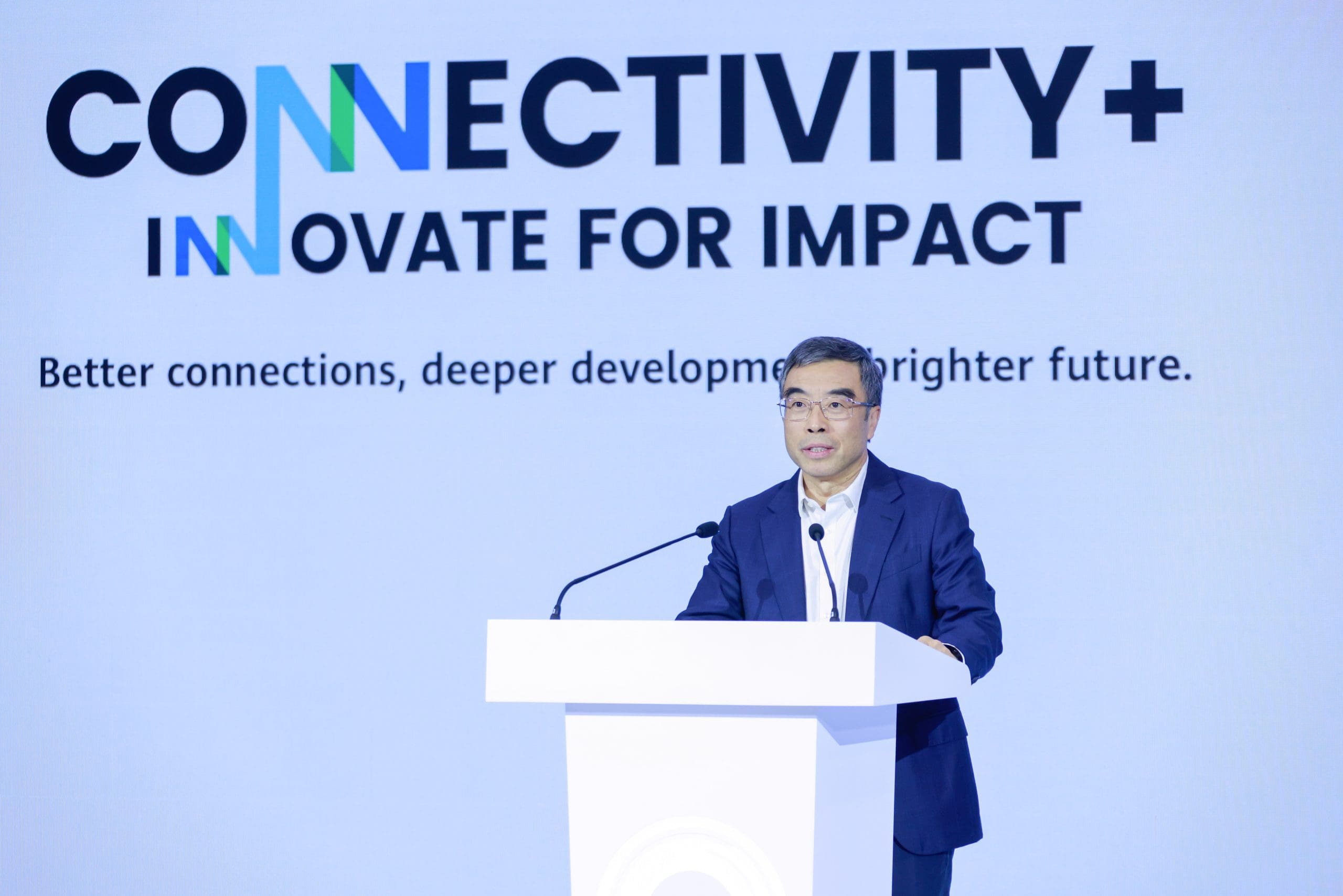
Speech by Dr. Liang Hua, Chairman of board, Huawei Technologies at Huawei Sustainable Development Forum in Shenzhen.
Welcome to today’s forum. The theme of our event is “Connectivity+: Innovate for Impact”.
Today, we will explore how we can innovate together to drive broader connectivity in the digital economy era, and how we can use ubiquitous connectivity to create greater business and social value and promote sustainability.
To begin, I’d like to discuss three stories and share thoughts on the digital future.
The first is about how a digital platform is saving lives in Nigeria. Delivering the right medical supplies as quickly as possible can be a matter of life and death. LifeBank, a local digital health platform, connects hospitals with supply centers. It offers real-time access to blood and oxygen products, and guarantees quality services via end-to-end management, from sourcing and location, to tracking and delivery. When a hospital urgently needs blood, it can log in to the platform and submit a request. The dispatch rider then uses mobile location services to find the quickest route to the hospital. This ensures that blood rapidly reaches those in need, safeguarding their health and even saving lives.
The second is about how AI is protecting a wetland in Grosseto, Italy. This oasis consists of sand dunes and Mediterranean forests, and is home to more than 300 species of birds. In recent years, it has been plagued by poaching and illegal logging. To address this, the World Wide Fund for Nature, Huawei, and Rainforest Connection came together in 2019 and developed an AI- and cloud-based acoustic monitoring system.
The system works by deploying mobile devices throughout the wetland. These devices operate 24/7, even in extreme conditions, and collect huge amounts of audio data that are then transmitted to the cloud over local mobile networks. Such data is then analyzed by AI. The system gives alerts whenever it detects the sound of illegal logging, contributing greatly to local conservation and restoration.
The third story is about how connectivity is driving mobile payments to enable financial inclusion in Bangladesh. The country has 165 million people, making it one of the most densely populated nations in the world. Over 70% of its people live in rural areas, where major banks struggle to reach customers. This adds to the difficulty of making deposits and withdrawals. Residents also have to travel long distances to reach a bank, and provide supporting materials to open a bank account.
To tackle this problem, bKash and Huawei have launched a mobile e-wallet service. People can use the app to deposit and withdraw money on their mobile phones. If they cannot download the app, they can still register using short codes or at telecom shops to enjoy transfer, withdrawal, and payment services. Advances in connectivity have reshaped transaction models, changing our lives and driving social progress.
Connectivity plays an important role in every aspect of our lives. It makes lives easier and healthier, economies stronger, and the environment greener.
We are now moving from the mobile Internet era to the intelligent era. In this new era, where everything will be connected, connectivity will be more than just a tool for convenient communications. Together with digital technologies like cloud and AI, connectivity will help bring everyone into the digital world and drive social progress. It is essential for those benefits to reach all, because we believe that connectivity is not just the cornerstone of the digital economy, but a basic right for every human being. To make this a reality, we are working more closely with industry organizations and partners in two areas.
First, we are working to enhance digital literacy and develop digital talent to bridge the digital divide
Bringing stable connectivity to all is still a challenge. Many people around the world remain unconnected. So connecting them is the first step. This will give them greater access to knowledge, digital skills training, and opportunities.
According to the GSMA’s Mobile Economy Report 2022, only 6% of the world’s population live in areas without mobile network coverage. But a huge usage gap remains, as many people who have coverage still don’t use the Internet. In 2021, the usage gap was 3.2 billion people, or 41% of the world’s population. So, there is still a long way to go before everyone has easy access to quality Internet services.
For more than 30 years, Huawei has committed itself to pushing the boundaries of ICT and promoting global adoption. By working closely with operators from around the world, we have built over 1,500 networks that connect more than three billion people in more than 170 countries and regions.
In China, we have helped operators expand the coverage of high-speed mobile networks and make 4G or even 5G networks accessible to almost every rural village.
Outside China, Huawei’s RuralStar solutions have connected even more people, providing easier access to information and services. These solutions have connected people from border towns in Africa to uncovered white zones in developed regions. By the end of 2021, RuralStar solutions had helped connect 60 million people in remote areas in more than 70 countries.
Today, we are happy to announce that Huawei is making a pledge to ITU’s Partner2Connect. By 2025, Huawei’s ICT solutions will bring connectivity to 120 million people in remote areas from over 80 countries.
In addition to connectivity, we support inclusive development and are working to drive broader digital inclusion through our TECH4ALL program. By the end of 2021, the TECH4ALL program had helped more than 110,000 people, including teachers and students from over 400 schools, and unemployed young people, learn new digital skills and improve their scientific and technological literacy. In addition, each month, the accessibility functions on Huawei devices help 4.4 million visually impaired users and over 800,000 hearing impaired users use digital technology more seamlessly.
Second, we are working together to accelerate digitalisation for stronger digital and real economies.
The digital economy has become a key driver of the global economy. It’s growing faster, spurring more innovation, and creating greater impact than any other segment of the economy. It’s estimated that over 50% of global GDP will be digitalized this year. As digital technology enables more industries to go digital, the digital economy is becoming increasingly integrated with the real economy. This will greatly promote economic stability and sustainability worldwide.
Over the past few years, digital technologies like 5G, cloud, and AI have been rapidly converging. 5G, a next-generation infrastructure for connectivity, has become a key enabler as it supports stable data transmission, real-time computing, and always-on services. 5G has the potential to improve productivity and create significant value for society.
In agriculture, drones that use 5G and AI can enable precision weeding to help significantly reduce pesticide use and make agricultural production safer and more eco-friendly.
In coal mines, 5G has enabled remotely controlled operations, allowing miners to step out of the mines and work from offices above ground. This has greatly improved the working environment and mine safety.
In ports, 5G and L4 autonomous driving are enabling automatic and intelligent loading, unloading, stacking, and more. This is making ports safer and more efficient.
However, there is a growing digital gap between SMEs and leading enterprises, as SMEs are working on the first step of digital transformation – trying to get everything connected. To this end, Huawei announced last year that it will invest 100 million US dollars into the Spark Program in the Asia-Pacific region over the next three years. Through this program, we share our extensive ICT experience and cloud platform resources with startups. This gives them the resources needed to go digital and achieve business success.
The intelligent world is fast approaching. The new ubiquitous connectivity, enabled by 5.5G, F5.5G, Net5.5G, and more, has the potential to create new business value and greater social value. Huawei is committed to working with its global partners for shared success. We will innovate together to maximize the impact of connectivity and promote greater sustainability. By coming together, we can build a better, fully connected, intelligent world.
