
Close Menu
  • Homepage
  • News
  • Cloud & AI
  • ECommerce
  • Entertainment
  • Finance
  • Opinion
  • Podcast
  • Contact

Subscribe to Updates

Get the latest technology news from TechFinancials News about FinTech, Tech, Business, Telecoms and Connected Life.

What's Hot

Bridging Financial Frontiers: ZOOMEX Launches “February XAUT Airdrop Event”

2026-02-03

Why Haier, World’s #1 Appliance Maker, Is Targeting South Africa

2026-02-03

Disney+ Brings Love Story: John F. Kennedy Jr. & Carolyn Bessette

2026-02-03
Facebook X (Twitter) Instagram
Trending
  • Bridging Financial Frontiers: ZOOMEX Launches “February XAUT Airdrop Event”
Facebook X (Twitter) Instagram YouTube LinkedIn WhatsApp RSS
TechFinancials
  • Homepage
  • News
  • Cloud & AI
  • ECommerce
  • Entertainment
  • Finance
  • Opinion
  • Podcast
  • Contact
TechFinancials
Home»Opinion»Forensic Science Is Unlocking The Mysteries Of Fatal Lightning Strikes
Opinion

Forensic Science Is Unlocking The Mysteries Of Fatal Lightning Strikes

The ConversationBy The Conversation2021-11-04No Comments6 Mins Read
Share Facebook Twitter Pinterest LinkedIn Tumblr Email
lightning
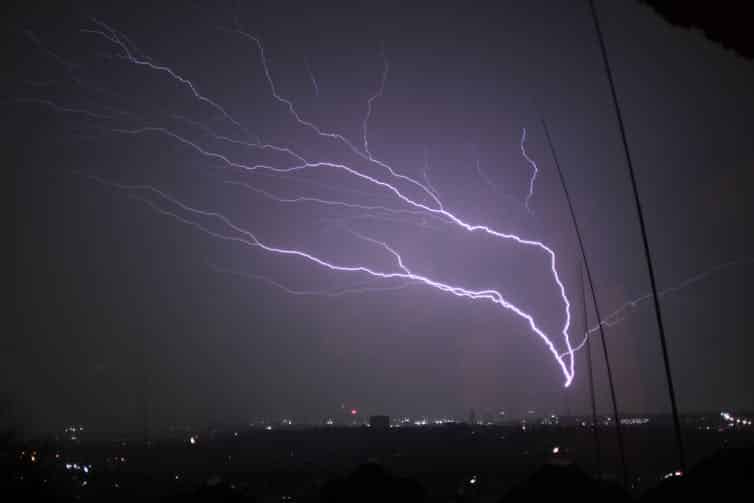
Lightning storm over Johannesburg, South Africa. Dr Carina Schumann, Johannesburg Lightning Research Lab, University of the Witwatersrand., CC BY-NC
Share
Facebook Twitter LinkedIn Pinterest Email Copy Link

Lightning is one of the most powerful sources of energy in the natural environment. As anyone who has spent time in Johannesburg during the South African summer will attest, there is nothing as spectacular as a Highveld thunderstorm at the end of a long, hot day: the scent of petrichor, torrents of cooling rain, booms of thunder and great spears of lightning across the sky.

These storms are awe inspiring – but also dangerous to people, animals and the built environment. African countries, among them Zambia and Uganda, have some of the highest lightning fatality rates in the world. In South Africa, more than 250 people are killed by lightning annually.

The exact number of deaths isn’t clear, due to under reporting, but estimates from 28 countries suggest there are up to 24,000 lightning fatalities annually worldwide.

Deaths can’t always be definitely attributed to lightning because, while its marks are easy to spot on the skin or in the organs, nobody was sure how to identify its marks on skeletonised remains.

Play
Lightning storm over Johannesburg, South Africa. Video produced by Patrick Randolph-Quinney (Northumbria University and the University of the Witwatersrand).

Our research changes this. Our study, published in the journal Forensic Science International: Synergy, represents collaboration between specialists in forensic anthropology, histology, lightning physics, and micro-focus X-ray computed tomography from the universities of the Witwatersrand in South Africa, Northumbria in the UK, and the Nuclear Energy Corporation of South Africa.

This work can help forensic teams understand whether people or animals were the victims of fatal lightning strikes, based solely on an analysis of their skeletons. This may allow an attribution of accidental death in cases where cause is not apparent, and allow experts to build a more complete picture of the true incidence of lightning fatalities.

Cause and effect

When a lightning death is suspected, forensic pathologists determine cause of death by looking for signs of lightning trauma in the deceased’s skin and internal organs.

When a body is struck, fatally or not, the immense electrical current can cause cardiac and respiratory arrest, as well as neurological damage. Ear drums may rupture; bones may fracture, and there will be severe electrical burns at entry and exit sites, particularly on the soles of the feet. Lightning can also produce unique markers in the skin, termed Lichtenberg figures. These are branching or fern-like patterns caused by electrical damage to superficial blood vessels in the skin.

However, when a skeletonised body is recovered, soft tissues are absent; lightning cannot confidently be attributed as the cause of death.

Our research started with a simple question of cause and effect: does lightning leave recognisable traumatic traces or characteristic lesions when passing through the skeleton? If we discovered unidentified human remains in the South African bush, could we determine whether they were the victim of a fatal lightning strike?

We then generated artificial lightning in the laboratory applied directly to human bone samples extracted from donated bodies who had died of natural causes.

Play
Artificial lightning produced in the lab passing through a block of human bone. Video produced by Patrick Randolph-Quinney (Northumbria University and the University of the Witwatersrand).

Lightning physicists set up a high-current impulse generator in our lab at the Wits Medical School which could deliver up to 15,000 amps to the bone in a few micro seconds.

Generating such high impulse currents allowed us to mimic the effect of lightning passing through the skeleton. Natural lightning can often have significantly higher current levels, but this experimental setup gave us much greater control than trying to somehow place human tissue in the path of a natural lightning strike.
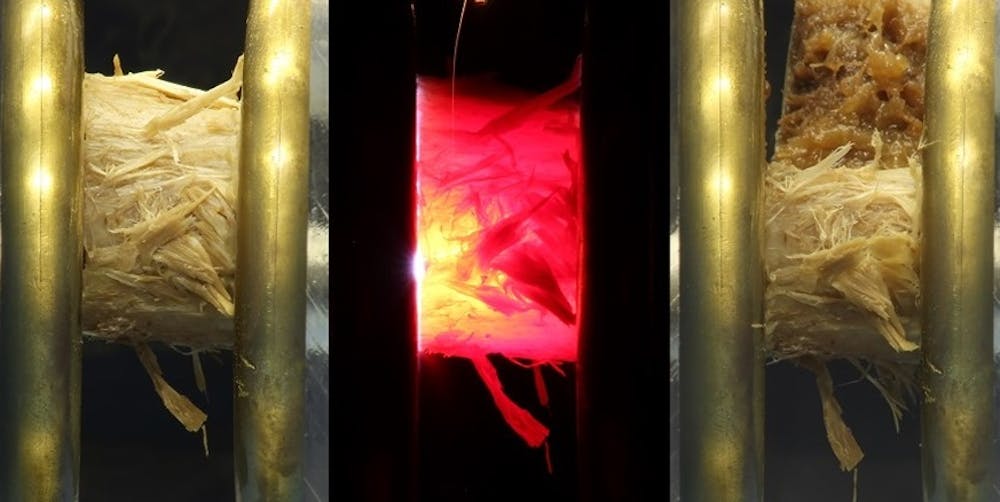
Experimental lightning trauma in action. Left image shows bone before current is applied. Middle image is a high-speed capture of the passage of current. Right image is the bone following current passage, with effects of barotrauma showing the splitting apart of bone tissue by internal pressure wave.
Nicholas Bacci, School of Anatomical Sciences and Hugh Hunt, Johannesburg Lightning Research Laboratory, University of the Witwatersrand.

Imaging lightning damage

Once the current was applied, we cut the bone into thin slices and imaged it using optical microscopy and micro-CT. By looking at the bone at a cellular level we saw there was a pattern of damage uniquely caused by short duration lightning current passing through its cells.

This damage took the form of cracks radiating out from the centre of canals in the bone, or jumping irregularly between clusters of cells. The overall pattern of damage looked very different when compared to other high energy trauma, such as that caused by burning in fire.

We saw the same pattern of trauma in animals killed by natural lightning. We compared the human results with bone from a wild giraffe that was known to have been struck; the pattern of damage was identical even though the micro-structure of human bone is very different from giraffe bone.
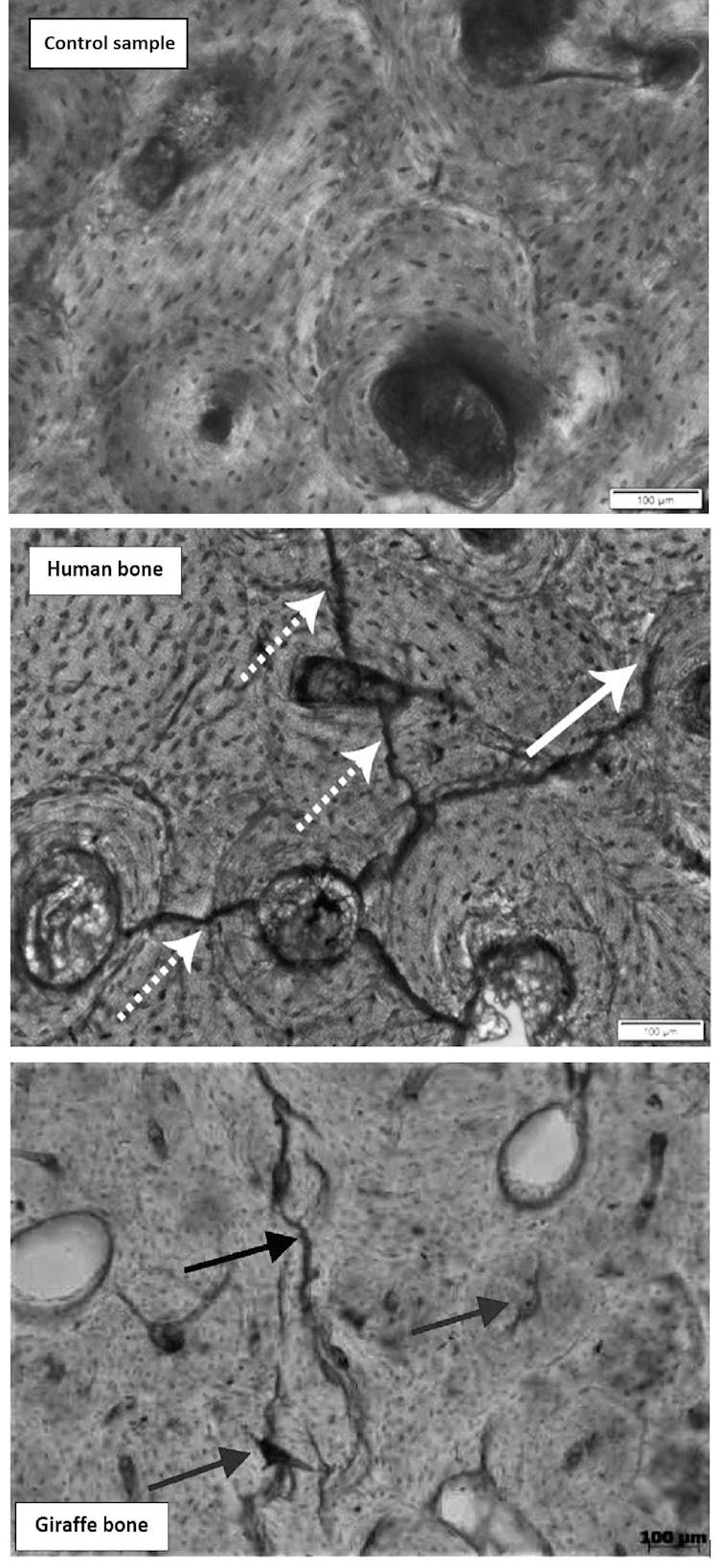
Patterns of micro-trauma and micro-factures caused by the passage of experimentally induced current in human bone (middle) and a known case of fatal natural lightning strike in a juvenile giraffe (bottom). A control sample of human bone (undamaged) is seen in the top panel.
Patrick Randolph-Quinney, Forensic Science Research Group, Northumbria University and Tanya Augustine & Nicholas Bacci, School of Anatomical Sciences, University of the Witwatersrand.

The smoking gun

So, what was the specific mechanism that caused these micro-fractures to form? We think there are two options which, alone or in combination, would produce this damage.

Firstly, the current itself produces a high-pressure shock wave when travelling through the bone. Lightning specialists term this barotrauma: the passage of electrical energy literally blows bone cells apart.

Secondly, bone behaves strangely when placed in an electric field. This is termed a piezoelectric effect. Collagen, the organic part of bone, is arranged as fibres or fibrils. These fibrils rearrange themselves when a current is applied, causing stress to build up in the mineralised and crystallised component of bone, in turn leading to deformation and cracking.

Both of these mechanisms would cause fractures to form. This unique pattern of micro-trauma was the smoking gun we were looking for.

Our research offers a new tool to study lightning fatality in real-world forensic cases. At a time when global climate change may be driving increases in the number and severity of thunderstorms and lightning strikes, this tool may sadly have to be called upon regularly in death investigation.The Conversation

Patrick Randolph-Quinney, Associate Professor of Forensic Science, Northumbria University, Newcastle; Nicholas Bacci, Lecturer, School of Anatomical Sciences, University of the Witwatersrand, and Tanya Nadine Augustine, Senior Lecturer, University of the Witwatersrand

This article is republished from The Conversation under a Creative Commons license. Read the original article.

bONE electrical Forensic lightning University of Witwatersrand
Share. Facebook Twitter Pinterest LinkedIn Tumblr Email
The Conversation
  • Website

Related Posts

Why South Africa Cannot Afford To Wait For Healthcare Reform

2026-02-02

SA Auto Industry At Crossroads: Cheap Imports Threaten Future

2026-02-02

Stablecoins: The Quiet Revolution South Africa Can’t Ignore

2026-02-02

South Africa Could Unlock SME Growth By Exploiting AI’s Potential Through Corporate ESD Funds

2026-01-28

How Local Leaders Can Shift Their Trajectory In 2026

2026-01-23

Why Legal Businesses Must Lead Digital Transformation Rather Than Chase It

2026-01-23

Directing The Dual Workforce In The Age of AI Agents

2026-01-22

The Productivity Myth That’s Costing South Africa Talent

2026-01-21

The Boardroom Challenge: Governing AI, Data And Digital

2026-01-20
Leave A Reply Cancel Reply

DON'T MISS
Breaking News

Dutch Entrepreneurial Development Bank FMO Invests R340M In Lula To Expand SME funding In SA

South African SME funding platform Lula has secured R340 million in local currency funding from…

Paarl Mall Gets R270M Mega Upgrade

2026-02-02

Huawei Says The Next Wave Of Infrastructure Investment Must Include People, Not Only Platforms

2026-01-21

South Africa: Best Starting Point In Years, With 3 Clear Priorities Ahead

2026-01-12
Stay In Touch
  • Facebook
  • Twitter
  • YouTube
  • LinkedIn
OUR PICKS

South Africa’s First Institutional Rand Stablecoin, ZARU, Launches

2026-02-03

What’s Stopping Sunny South Africa’s Solar Industry?

2026-02-02

The EX60 Cross Country: Built For The “Go Anywhere” Attitude

2026-01-23

Mettus Launches Splendi App To Help Young South Africans Manage Their Credit Health

2026-01-22

Subscribe to Updates

Get the latest tech news from TechFinancials about telecoms, fintech and connected life.

About Us

TechFinancials delivers in-depth analysis of tech, digital revolution, fintech, e-commerce, digital banking and breaking tech news.

Facebook X (Twitter) Instagram YouTube LinkedIn WhatsApp Reddit RSS
Our Picks

Bridging Financial Frontiers: ZOOMEX Launches “February XAUT Airdrop Event”

2026-02-03

Why Haier, World’s #1 Appliance Maker, Is Targeting South Africa

2026-02-03

Disney+ Brings Love Story: John F. Kennedy Jr. & Carolyn Bessette

2026-02-03
Recent Posts
  • Bridging Financial Frontiers: ZOOMEX Launches “February XAUT Airdrop Event”
  • Why Haier, World’s #1 Appliance Maker, Is Targeting South Africa
  • Disney+ Brings Love Story: John F. Kennedy Jr. & Carolyn Bessette
  • Navigating Your Security in Modern Mobile Betting
  • Crypto Investors Go Wild On X For Remittix 300% Bonus Offer!
TechFinancials
RSS Facebook X (Twitter) LinkedIn YouTube WhatsApp
  • Homepage
  • Newsletter
  • Contact
  • Advertise
  • Privacy Policy
  • About
© 2026 TechFinancials. Designed by TFS Media. TechFinancials brings you trusted, around-the-clock news on African tech, crypto, and finance. Our goal is to keep you informed in this fast-moving digital world. Now, the serious part (please read this): Trading is Risky: Buying and selling things like cryptocurrencies and CFDs is very risky. Because of leverage, you can lose your money much faster than you might expect. We Are Not Advisors: We are a news website. We do not provide investment, legal, or financial advice. Our content is for information and education only. Do Your Own Research: Never rely on a single source. Always conduct your own research before making any financial decision. A link to another company is not our stamp of approval. You Are Responsible: Your investments are your own. You could lose some or all of your money. Past performance does not predict future results. In short: We report the news. You make the decisions, and you take the risks. Please be careful.

Type above and press Enter to search. Press Esc to cancel.

Ad Blocker Enabled!
Ad Blocker Enabled!
Our website is made possible by displaying online advertisements to our visitors. Please support us by disabling your Ad Blocker.