
Close Menu
  • Homepage
  • News
  • Cloud & AI
  • ECommerce
  • Entertainment
  • Finance
  • Opinion
  • Podcast
  • Contact

Subscribe to Updates

Get the latest technology news from TechFinancials News about FinTech, Tech, Business, Telecoms and Connected Life.

What's Hot

Digitap ($TAP) Crushes NexChain with Real Banking Utility: Best Crypto to Buy in 2026

2026-02-07

Football Fans Can Share Their ‘Super Bowl Spread’  With The Chance To Win an NFL Jersey

2026-02-07

Why Traditional Banks Need Mobile Money Solutions to Survive the Next 5 Years

2026-02-07
Facebook X (Twitter) Instagram
Trending
  • Digitap ($TAP) Crushes NexChain with Real Banking Utility: Best Crypto to Buy in 2026
Facebook X (Twitter) Instagram YouTube LinkedIn WhatsApp RSS
TechFinancials
  • Homepage
  • News
  • Cloud & AI
  • ECommerce
  • Entertainment
  • Finance
  • Opinion
  • Podcast
  • Contact
TechFinancials
Home»Opinion»Smart water heating could help in South Africa’s energy crisis
Opinion

Smart water heating could help in South Africa’s energy crisis

ContributorBy Contributor2020-02-03No Comments4 Mins Read
Share Facebook Twitter Pinterest LinkedIn Tumblr Email
By centrally controlling when household water heaters (geysers) can be switched on and off, South Africa can ease up electricity demand during peak consumption times
By centrally controlling when household water heaters (geysers) can be switched on and off, South Africa can ease up electricity demand during peak consumption times. Shutterstock
Share
Facebook Twitter LinkedIn Pinterest Email Copy Link

by MJ (Thinus) Booysen

South Africa’s energy crisis has many dimensions, from political and economic to technical and environmental. Recently, the country’s power utility, Eskom, has been generating only about 60% of its capacity and has had to restrict usage to prevent a regional blackout.

Eskom’s new chief executive officer has affirmed the importance of demand management to handle the crisis. But his approach of merely “subsidising energy-efficient lightbulbs” won’t cut it. The country needs drastic interventions – and the elements of the fourth industrial revolution are available to make this possible. These are: wireless connectivity, the internet of things, big data analysis, machine learning, artificial intelligence and intelligent centralised control.

One of the biggest consumers of energy in South Africa is the electric water heater, or “geyser”. The estimated 5.4 million electric water heaters in South African homes and public buildings use around 40 GWh of energy per day, draining more than 4 GW, 12% of operational capacity from the electricity grid at peak times.

What tends to be overlooked is that these water heaters are perfect for storing thermal energy. They absorb electrical energy when heating water, and discharge thermal energy later when the hot water is used, with little loss in between. This makes them well suited for flattening the grid’s morning and evening demand peaks. Centrally switching them on during off-peak times would distribute demand for electricity more evenly through the day.
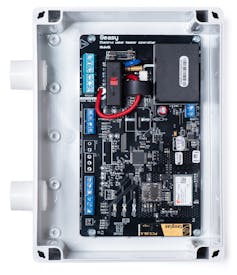
An electric water heater controller.
Provided by author.

The benefits of scheduling heaters don’t stop there though. Our research has shown that the energy they guzzle, and the resulting emissions, can be significantly reduced too by applying optimal scheduling – also see our helpful online calculator.

Two thorny issues compete with demand and energy management in water heating. One is customer satisfaction. The most energy-efficient and demand-optimal water heater is one that is never turned on, but who wants a cold shower?

The other is customer safety. A water heater running at a low temperature can promote the growth of harmful bacteria. We have detected potentially lethal Legionella bacteria in water heaters and downstream pipes, and even in heaters that are set to high temperatures.

What needs to be done

The bulk switching off of water heaters, called “ripple control”, has been used to do demand management for decades. But this unidirectional approach is not enough to ensure energy savings, and could lead to unhappy users.

The problem can be overcome using the tools of the fourth industrial revolution. They can reduce the amount of energy that customers use to heat water, and thus the aggregate load on the grid, without sacrificing user satisfaction or encouraging disease. We have demonstrated this in our recently published paper on comfort, peak load and energy.

A network of smart water heaters is required to realise the full benefits of scheduling water heaters. These measure and report water and energy usage, remotely control the heating schedule and temperature of each water heater and can learn the user’s behavioural patterns.

Individual water heaters could be switched on and off centrally at times that would distribute demand for electricity more evenly through the day while ensuring optimal energy savings for all. We developed and used such a network in our research and demonstrated the efficacy of such a solution.

By introducing individualised optimal temperature-schedule control, we showed that energy savings ranging from 8% to 18% are realistic. This is without taking into account the additional savings that’ll result because unintentional hot water use will be at lower temperatures.

It also excludes the savings achieved through high-resolution smart-meter information leading to behavioural change. Taking these extras into account we observed energy savings of 29%, albeit in a small sample.

The ripple effect

This technology has the potential to curb South Africa’s costly diesel habit, reduce the country’s CO₂ footprint and reduce the triggering threshold for rolling blackouts by at least 2 GW.

Also, with the increased introduction of and dependence on unpredictable solar and wind power, a network of delay-tolerant smart water heaters could help stabilise the grid.

Insurers are likely to play intermediaries between the user and the utility, since smart water heaters limit damage that results from mechanical failures. With thousands of heaters under their control, they could then sell large-scale demand management as a service to the struggling utility, while providing a value-add service to customers. What’s more, retrofitting existing water heaters will create jobs for installers and stimulate local manufacturing. Given the multidimensional impact of blackouts, all new water heaters should be smart from the outset.The Conversation

MJ (Thinus) Booysen, Associate Professor at the Electrical & Electronic Engineering Department, Stellenbosch University

This article is republished from The Conversation under a Creative Commons license. Read the original article.

electricity bills Eskom Power grid Smart water heating South Africa
Share. Facebook Twitter Pinterest LinkedIn Tumblr Email
Contributor

Related Posts

Private Credit Rating Agencies Shape Africa’s Access To Debt. Better Oversight Is Needed

2026-02-03

Why South Africa Cannot Afford To Wait For Healthcare Reform

2026-02-02

SA Auto Industry At Crossroads: Cheap Imports Threaten Future

2026-02-02

Stablecoins: The Quiet Revolution South Africa Can’t Ignore

2026-02-02

South Africa Could Unlock SME Growth By Exploiting AI’s Potential Through Corporate ESD Funds

2026-01-28

Eskom and the Netherlands launch Grootvlei Climate Smart Horticulture Centre in Mpumalanga

2026-01-26

How Local Leaders Can Shift Their Trajectory In 2026

2026-01-23

Why Legal Businesses Must Lead Digital Transformation Rather Than Chase It

2026-01-23

Directing The Dual Workforce In The Age of AI Agents

2026-01-22
Leave A Reply Cancel Reply

DON'T MISS
Breaking News

Digitap ($TAP) Crushes NexChain with Real Banking Utility: Best Crypto to Buy in 2026

The crypto presale market in 2026 has seen dozens of projects compete for investor attention.…

Dutch Entrepreneurial Development Bank FMO Invests R340M In Lula To Expand SME funding In SA

2026-02-03

Paarl Mall Gets R270M Mega Upgrade

2026-02-02

Huawei Says The Next Wave Of Infrastructure Investment Must Include People, Not Only Platforms

2026-01-21
Stay In Touch
  • Facebook
  • Twitter
  • YouTube
  • LinkedIn
OUR PICKS

Vodacom Reports Robust Q3 Growth, Driven By Diversification And Strategic Moves

2026-02-04

South Africa’s First Institutional Rand Stablecoin, ZARU, Launches

2026-02-03

The EX60 Cross Country: Built For The “Go Anywhere” Attitude

2026-01-23

Mettus Launches Splendi App To Help Young South Africans Manage Their Credit Health

2026-01-22

Subscribe to Updates

Get the latest tech news from TechFinancials about telecoms, fintech and connected life.

About Us

TechFinancials delivers in-depth analysis of tech, digital revolution, fintech, e-commerce, digital banking and breaking tech news.

Facebook X (Twitter) Instagram YouTube LinkedIn WhatsApp Reddit RSS
Our Picks

Digitap ($TAP) Crushes NexChain with Real Banking Utility: Best Crypto to Buy in 2026

2026-02-07

Football Fans Can Share Their ‘Super Bowl Spread’  With The Chance To Win an NFL Jersey

2026-02-07

Why Traditional Banks Need Mobile Money Solutions to Survive the Next 5 Years

2026-02-07
Recent Posts
  • Digitap ($TAP) Crushes NexChain with Real Banking Utility: Best Crypto to Buy in 2026
  • Football Fans Can Share Their ‘Super Bowl Spread’  With The Chance To Win an NFL Jersey
  • Why Traditional Banks Need Mobile Money Solutions to Survive the Next 5 Years
  • Spotify Brings Audiobooks to South Africa
  • Anjouan Corporate Services Reshapes Cross-Border Brokerage Licensing Strategy for UAE-Focused Firms
TechFinancials
RSS Facebook X (Twitter) LinkedIn YouTube WhatsApp
  • Homepage
  • Newsletter
  • Contact
  • Advertise
  • Privacy Policy
  • About
© 2026 TechFinancials. Designed by TFS Media. TechFinancials brings you trusted, around-the-clock news on African tech, crypto, and finance. Our goal is to keep you informed in this fast-moving digital world. Now, the serious part (please read this): Trading is Risky: Buying and selling things like cryptocurrencies and CFDs is very risky. Because of leverage, you can lose your money much faster than you might expect. We Are Not Advisors: We are a news website. We do not provide investment, legal, or financial advice. Our content is for information and education only. Do Your Own Research: Never rely on a single source. Always conduct your own research before making any financial decision. A link to another company is not our stamp of approval. You Are Responsible: Your investments are your own. You could lose some or all of your money. Past performance does not predict future results. In short: We report the news. You make the decisions, and you take the risks. Please be careful.

Type above and press Enter to search. Press Esc to cancel.

Ad Blocker Enabled!
Ad Blocker Enabled!
Our website is made possible by displaying online advertisements to our visitors. Please support us by disabling your Ad Blocker.