
Close Menu
  • Homepage
  • News
  • Cloud & AI
  • ECommerce
  • Entertainment
  • Finance
  • Opinion
  • Podcast
  • Contact

Subscribe to Updates

Get the latest technology news from TechFinancials News about FinTech, Tech, Business, Telecoms and Connected Life.

What's Hot

Digitap ($TAP) Crushes NexChain with Real Banking Utility: Best Crypto to Buy in 2026

2026-02-07

Football Fans Can Share Their ‘Super Bowl Spread’  With The Chance To Win an NFL Jersey

2026-02-07

Why Traditional Banks Need Mobile Money Solutions to Survive the Next 5 Years

2026-02-07
Facebook X (Twitter) Instagram
Trending
  • Digitap ($TAP) Crushes NexChain with Real Banking Utility: Best Crypto to Buy in 2026
Facebook X (Twitter) Instagram YouTube LinkedIn WhatsApp RSS
TechFinancials
  • Homepage
  • News
  • Cloud & AI
  • ECommerce
  • Entertainment
  • Finance
  • Opinion
  • Podcast
  • Contact
TechFinancials
Home»Opinion»How The Price of Bandwidth Can Be Cut in African Countries
Opinion

How The Price of Bandwidth Can Be Cut in African Countries

ContributorBy Contributor2019-12-19No Comments4 Mins Read
Share Facebook Twitter Pinterest LinkedIn Tumblr Email
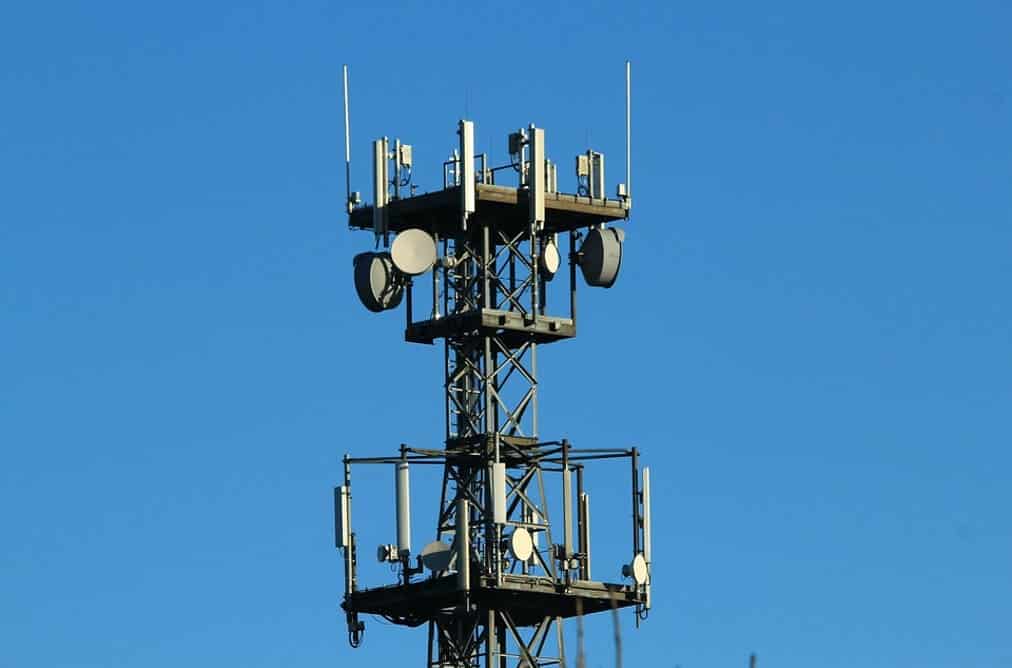
Internet accessibility in Africa is hampered by high prices. Wikimedia Commons
Share
Facebook Twitter LinkedIn Pinterest Email Copy Link

by Clement Prince Addo

All over the world, the internet has provided extraordinary socioeconomic opportunities to businesses, governments, and individuals. But less developed countries still face numerous obstacles to maximise its potential. The problems range from obsolete infrastructure, the nonavailability, non-accessibility, cost, power fluctuations, policies and regulation.

Many countries on the continent still have bandwidth as low as 64 kilobits. This is in contrast to the 270,000 megabits per second in the US. Data also shows that downloading a 5GB movie took 734 minutes in the Republic of Congo, 788 minutes in Sao Tome, 850 minutes in Ethiopia, 965 minutes in Niger and 1,342 minutes in Equatorial Guinea. Singapore is the fastest, taking about 11 minutes and 8 seconds to download a typical 5GB high-definition movie. In certain situations, bandwidths for the entire country is less than what is available to an individual residential subscriber in the US.

Similarly, African countries are listed among those with the lowest internet speed yet with the most expensive communication and internet cost in the world.

Africa is on record to have had the fastest growing mobile telecommunication market over the years. But the continent still has the lowest mobile penetration. And developments in Africa’s telecommunications sector happen in cities and urban centres. Service providers argue that it’s not economically feasible to roll out a network to cover an entire country .

But various advanced technologies are emerging to reduce the cost of internet provision and to increase accessibility. They also offer the possibility of developing communication networks in a way that does less harm to the environment.

The approach is called resource virtualisation, where multiple telecommunication services can be provided by less physical infrastructure. Since the chunk of the cost transferred to the end-user comes from the cost of power and infrastructural management, this approach can reduce the operational cost, improve accessibility and cut the cost to the end user.

Rethinking how masts are sited

Like every architectural work, telecommunication masts must meet specific constructional requirements, including choice of location and risk analysis. But unregulated construction is typical in many parts of Africa. Even where regulatory bodies exist, many media and communication masts are sited within very short distances and hilly grounds in big cities.

This is true in Ghana too where in an urban environment it’s possible to see 10 masts within close proximity to one another. This does not necessarily guarantee quality service. In addition, it poses a severe environmental and physical risk.
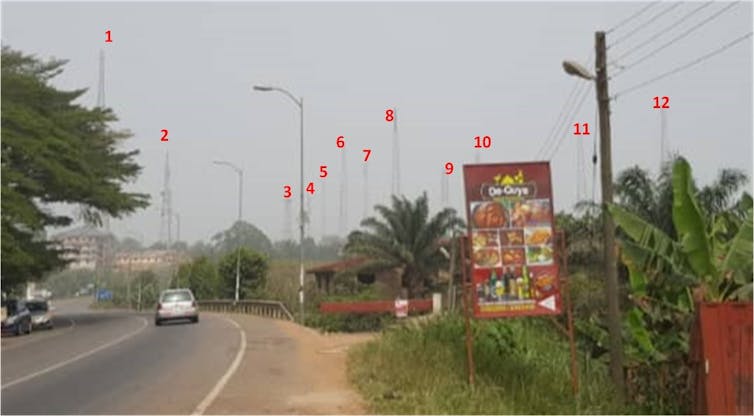
IMG WA.
Clement Prince Adu

Masts are also expensive to put up.

It stands to reason, therefore, that having fewer masts, hence using less energy and doing less damage to the environment would be the optimal way forward.

I have been involved in developing a framework along with other colleagues that can help policymakers demarcate, and zone major cities – or the whole country into zones. Each zone takes only one mast, owned by an infrastructure provider and shared by multiple service providers.

I focused on telecommunications, but the principle can be applied to TV and radio signal towers too.
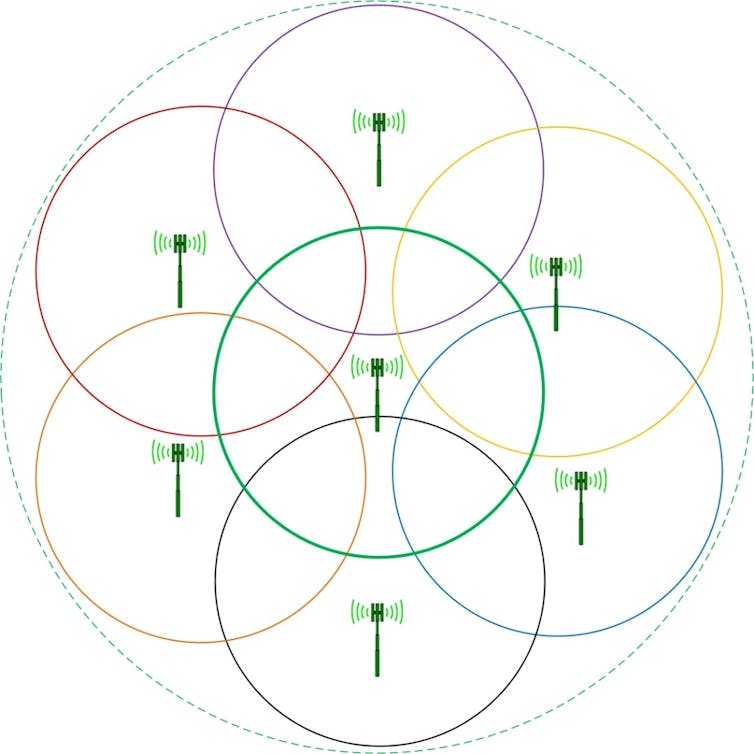
Proposed mast deployment.
Clement Prince Addo

My proposal involves a three-level architecture that includes a provider who owns and manages the infrastructure.

At the upper level is a Cloud-RAN macro-base station. A provider like the state regulator, can own and manage the data from the base station.

The macro base station is responsible for managing the system’s energy, bandwidth allocation, and flow management, including the handover in intra and inter mast zones. At the middle level, service providers focus on providing tailored and quality of service to their users. The service providers will not have to spend their resources on managing the infrastructure they only have to deal with how to satisfy users. The user on the third level has to only deal with the service providers.
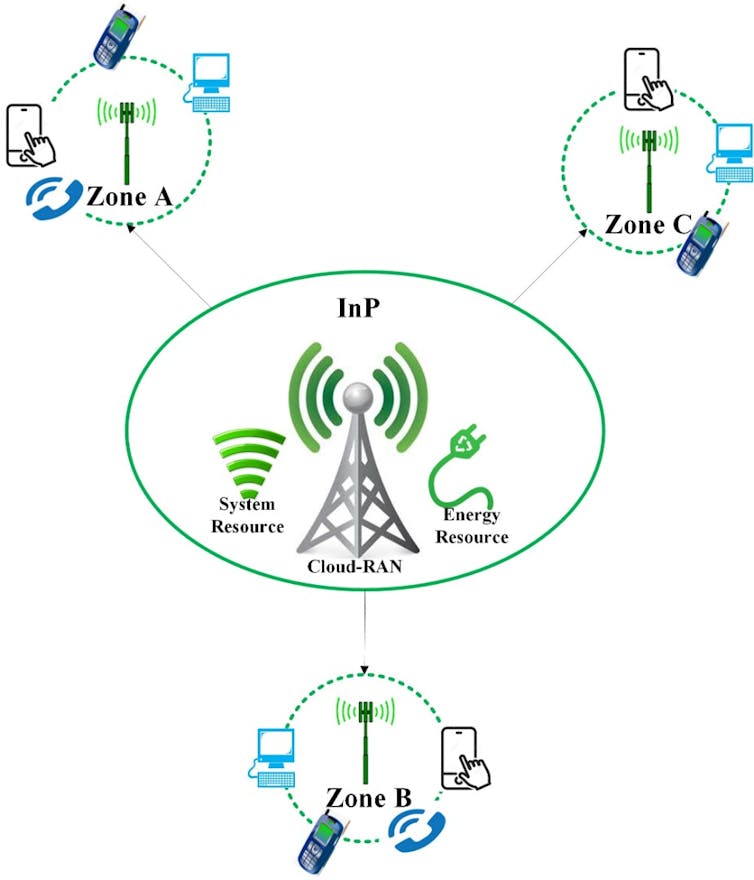
Association between service providers and users.
Clement Prince Addo

This framework will bring an end to uncontrolled mast deployment seen in many African countries. It would allow for power and bandwidth sharing among multiple service providers and would reduce the need for multiple masts. Traffic would be scheduled over limited masts or access points that reduce the system energy consumption and improve efficiency. The general impact on the environment would also be reduced.

Service providers could then focus on end-users and not on infrastructures.The Conversation

Clement Prince Addo, PhD Researcher, University of Electronic Science and Technology of China

This article is republished from The Conversation under a Creative Commons license. Read the original article.

Africa bandwidth Communication Internet Price of bandwidth technology
Share. Facebook Twitter Pinterest LinkedIn Tumblr Email
Contributor

Related Posts

Private Credit Rating Agencies Shape Africa’s Access To Debt. Better Oversight Is Needed

2026-02-03

Salesforce Appoints Nick Christodoulou As Area VP Of Sales For Africa

2026-02-02

Why South Africa Cannot Afford To Wait For Healthcare Reform

2026-02-02

How is Technology Used in Cricket?

2026-02-02

SA Auto Industry At Crossroads: Cheap Imports Threaten Future

2026-02-02

Stablecoins: The Quiet Revolution South Africa Can’t Ignore

2026-02-02

South Africa Could Unlock SME Growth By Exploiting AI’s Potential Through Corporate ESD Funds

2026-01-28

How Local Leaders Can Shift Their Trajectory In 2026

2026-01-23

Why Legal Businesses Must Lead Digital Transformation Rather Than Chase It

2026-01-23
Leave A Reply Cancel Reply

DON'T MISS
Breaking News

Digitap ($TAP) Crushes NexChain with Real Banking Utility: Best Crypto to Buy in 2026

The crypto presale market in 2026 has seen dozens of projects compete for investor attention.…

Dutch Entrepreneurial Development Bank FMO Invests R340M In Lula To Expand SME funding In SA

2026-02-03

Paarl Mall Gets R270M Mega Upgrade

2026-02-02

Huawei Says The Next Wave Of Infrastructure Investment Must Include People, Not Only Platforms

2026-01-21
Stay In Touch
  • Facebook
  • Twitter
  • YouTube
  • LinkedIn
OUR PICKS

Vodacom Reports Robust Q3 Growth, Driven By Diversification And Strategic Moves

2026-02-04

South Africa’s First Institutional Rand Stablecoin, ZARU, Launches

2026-02-03

The EX60 Cross Country: Built For The “Go Anywhere” Attitude

2026-01-23

Mettus Launches Splendi App To Help Young South Africans Manage Their Credit Health

2026-01-22

Subscribe to Updates

Get the latest tech news from TechFinancials about telecoms, fintech and connected life.

About Us

TechFinancials delivers in-depth analysis of tech, digital revolution, fintech, e-commerce, digital banking and breaking tech news.

Facebook X (Twitter) Instagram YouTube LinkedIn WhatsApp Reddit RSS
Our Picks

Digitap ($TAP) Crushes NexChain with Real Banking Utility: Best Crypto to Buy in 2026

2026-02-07

Football Fans Can Share Their ‘Super Bowl Spread’  With The Chance To Win an NFL Jersey

2026-02-07

Why Traditional Banks Need Mobile Money Solutions to Survive the Next 5 Years

2026-02-07
Recent Posts
  • Digitap ($TAP) Crushes NexChain with Real Banking Utility: Best Crypto to Buy in 2026
  • Football Fans Can Share Their ‘Super Bowl Spread’  With The Chance To Win an NFL Jersey
  • Why Traditional Banks Need Mobile Money Solutions to Survive the Next 5 Years
  • Spotify Brings Audiobooks to South Africa
  • Anjouan Corporate Services Reshapes Cross-Border Brokerage Licensing Strategy for UAE-Focused Firms
TechFinancials
RSS Facebook X (Twitter) LinkedIn YouTube WhatsApp
  • Homepage
  • Newsletter
  • Contact
  • Advertise
  • Privacy Policy
  • About
© 2026 TechFinancials. Designed by TFS Media. TechFinancials brings you trusted, around-the-clock news on African tech, crypto, and finance. Our goal is to keep you informed in this fast-moving digital world. Now, the serious part (please read this): Trading is Risky: Buying and selling things like cryptocurrencies and CFDs is very risky. Because of leverage, you can lose your money much faster than you might expect. We Are Not Advisors: We are a news website. We do not provide investment, legal, or financial advice. Our content is for information and education only. Do Your Own Research: Never rely on a single source. Always conduct your own research before making any financial decision. A link to another company is not our stamp of approval. You Are Responsible: Your investments are your own. You could lose some or all of your money. Past performance does not predict future results. In short: We report the news. You make the decisions, and you take the risks. Please be careful.

Type above and press Enter to search. Press Esc to cancel.

Ad Blocker Enabled!
Ad Blocker Enabled!
Our website is made possible by displaying online advertisements to our visitors. Please support us by disabling your Ad Blocker.