

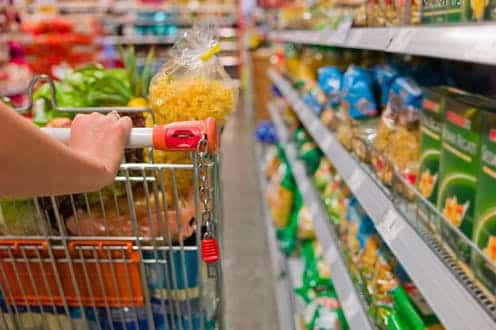
I have a radical suggestion: let’s ban processed and ultra-processed foods. Not the products, but the terms.
With so many diet plans and nutritional instructions offering such varied advice on how to eat healthily, a simple message like avoiding processed food is understandably attractive. As a result, some journalists, social media influencers and even health charities and academics have gathered behind the idea that processed food is bad for you – and so-called ultra-processed food is even worse.
This position has been taken to detailed extremes, with commandments not to eat food with more than five ingredients, with more than five steps in its manufacture, or even that contains any preservatives, “chemicals” or anything made in a factory.
As a food scientist, I think such blanket advice, while easy to remember, is ultimately unhelpful. The demonisation of processing promotes misunderstanding and mistrust of the ways in which science and manufacturing actually make food better for us.
For a start, all food is processed, and that’s a good thing. Processing is anything that transforms food from raw materials to something more suitable for human consumption. It can make food safer, more digestible and less susceptible to undesirable changes, while retaining or improving its nutritional and aesthetic qualities.
At its simplest, processing is cooking, the discovery of which has been highlighted as a key step in human evolution because it allowed us to absorb more energy to fuel our increasingly powerful bodies and brains. Today, besides a range of heat treatments that kill germs, other common processes used to preserve food include drying, fermentation, filtration, and freezing. In recent years, advanced treatments involving ultra-high pressures or pulsed electric fields have been proposed to make food safer to eat while preserving its taste, texture and nutritional value.
Read more:
Raw milk: the benefits are unclear but the dangers are real
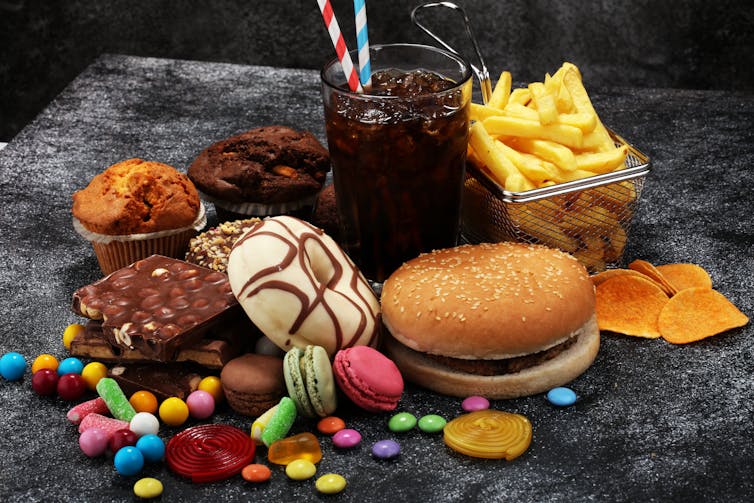
So why has the term “processed food” become so negative? Partly it’s because the term more often now refers to what’s in a food item and its nutritional information. In particular, it’s used to highlight foods with high levels of salt, sugar or fat, which can be linked to a range of health problems.
beast1/Shutterstock
Yet “processed food” is also often used to indicate products that contain a large number of ingredients, particularly what some deem “chemical” additives. It’s true that foods that haven’t had anything added to them can’t contain extra salt, sugar or fat. But there is no correlation between the number of ingredients and a product’s quality or safety.
Meanwhile even simple food products are likely to be made up of many chemical components. For example, a banana contains fructose, maltose, tocopherol, phylloquinone and 2-methylpropan-1-ol. An apple contains acetic acid (E260), tartaric acid (E334), carotene (E160a), ascorbic acid (vitamin C, E300) and citric acid (E330), among other compounds.
Those aren’t ingredients, you might say, but natural components. Mixing them together in a blender in the same proportions would not give the fruit back, or even the same nutritional profile. This may be the case, but they are still very clever assemblages of chemicals, often the exact same chemicals that can be found in manufactured food products with long lists of added ingredients.
Natural isn’t necessarily better
Many of these added chemicals are derived from natural sources. Others are often artificially synthesised versions of naturally occurring compounds, such as beta-carotene, which can be found in carrots, or vanillin, which is responsible for the flavour in vanilla. If the molecules from the factory and those from the carrot are identical, why is one seen as different to the other? Would it be preferable to have much more costly and wasteful processes to extract them from their natural sources?
Other ingredients are not found in natural food sources, and there is no question that, in the past (indeed for centuries), things were added to food that were not safe. For example, lead and mercury were once used as food colouring. However, today the food industry in many countries is highly regulated, and modern understanding of food science and safety has resulted in the prohibition of potentially harmful additives.
In Europe, food additives are given codes known as E-numbers. Research from 2007 that found six out of the hundreds of existing E-number additives were linked to hyperactivity in children led to the term becoming a pejorative description. But food containing any of those six compounds must now carry a warning label, while in all other cases an E-number actually reflects the fact that an additive has been tested and certified safe.
Olga Klochanko/Shutterstock
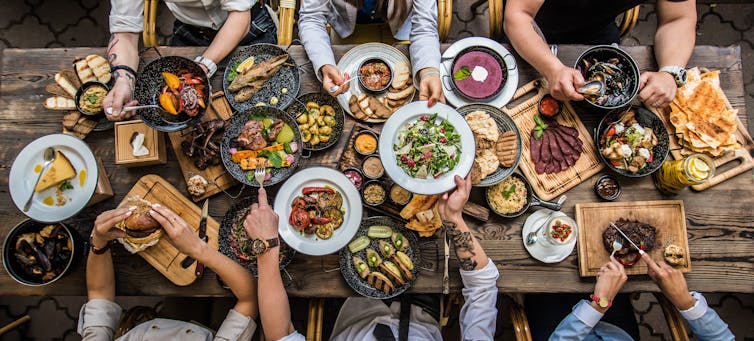
The other thing to remember about all the added ingredients in food products is that including them costs the manufacturers money and so they must serve a function. Today, consumers have an enormously diverse range of needs, and foods are becoming increasingly specialised and tailored, with categories for infants, the elderly, vegans, people with allergies and many other specific markets.
Making products that meet these people’s nutritional needs and still taste good often relies on large numbers of ingredients. Specialised products are needed to replace the nutrients of milk, the springiness provided by gluten, or the texture of meat. Food science has solved these problems by carefully optimising ingredients and control of their behaviour, from plant proteins for nutrition to xanthan gum for texture.
Ultimately, all food is made of chemicals, all ingredients have functions, and food products are not random assemblies of compounds added for no reason. These products are formulated to give them the number and type of ingredients they need to provide the nutritional, sensory, stability or safety attributes that consumers demand and legislation allows – no more and no less.
The merits of a food should not be judged on the basis of its ingredient list, and food processing is not something of which we should be suspicious. But understanding processing, and what ingredients are in food and why they are there, has never been more important.
Alan Kelly, Professor, Food Science and Technology, University College Cork
This article is republished from The Conversation under a Creative Commons license. Read the original article.
