

Close Menu
  • Homepage
  • News
  • Cloud & AI
  • ECommerce
  • Entertainment
  • Finance
  • Opinion
  • Podcast
  • Contact

Subscribe to Updates

Get the latest technology news from TechFinancials News about FinTech, Tech, Business, Telecoms and Connected Life.

What's Hot

Digitap ($TAP) Crushes NexChain with Real Banking Utility: Best Crypto to Buy in 2026

2026-02-07

Football Fans Can Share Their ‘Super Bowl Spread’  With The Chance To Win an NFL Jersey

2026-02-07

Why Traditional Banks Need Mobile Money Solutions to Survive the Next 5 Years

2026-02-07
Facebook X (Twitter) Instagram
Trending
  • Digitap ($TAP) Crushes NexChain with Real Banking Utility: Best Crypto to Buy in 2026
Facebook X (Twitter) Instagram YouTube LinkedIn WhatsApp RSS
TechFinancials
  • Homepage
  • News
  • Cloud & AI
  • ECommerce
  • Entertainment
  • Finance
  • Opinion
  • Podcast
  • Contact
TechFinancials
Home»Opinion»Silicon Valley Wants to Read Your Mind – Here’s Why you Should be Worried
Opinion

Silicon Valley Wants to Read Your Mind – Here’s Why you Should be Worried

ContributorBy Contributor2019-08-19No Comments5 Mins Read
Share Facebook Twitter Pinterest LinkedIn Tumblr Email
Side view of a blond businesswoman looking at her smartphone screen standing near a dark blue wall. There is a large blue brain hologram around her head.
Side view of a blond businesswoman looking at her smartphone screen standing near a dark blue wall. There is a large blue brain hologram around her head. Image Flow/Shutterstock
Share
Facebook Twitter LinkedIn Pinterest Email Copy Link

by Garfield Benjamin

Not content with monitoring almost everything you do online, Facebook now wants to read your mind as well. The social media giant recently announced a breakthrough in its plan to create a device that reads people’s brainwaves to allow them to type just by thinking. And Elon Musk wants to go even further. One of the Tesla boss’s other companies, Neuralink, is developing a brain implant to connect people’s minds directly to a computer.

Musk admits that he takes inspiration from science fiction, and that he wants to make sure humans can “keep up” with artificial intelligence. He seems to have missed the part of sci-fi that acts as a warning for the implications of technology.

These mind-reading systems could affect our privacy, security, identity, equality and personal safety. Do we really want all that left to companies with philosophies such as that of Facebook’s former mantra, “move fast and break things”?

Though they sound futuristic, the technologies needed to make brainwave-reading devices are not that dissimilar to the standard MRI (magnetic resonance imaging) and EEG (electroencephalography) neuroscience tools used in hospitals all over the world. You can already buy a kit to control a drone with your mind, so using one to type out words is, in some ways, not that much of a leap. The advance will likely be due to the use of machine learning to sift through huge quantities of data collected from our brains and find the patterns in neuron activity that link thoughts to specific words.

A brain implant is likely to take a lot longer to develop, and it’s important to separate out the actual achievements of Neuralink from media hype and promotion. But Neuralink has made simultaneous improvements in materials for electrodes and robot-assisted surgery to implant them, packaging the technology neatly so it can be read via USB.

Play

Facebook and Neuralink’s plans may build on established medical practice. But when companies are collecting thoughts directly from our brains, the ethical issues are very different.

Any system that could collect data directly from our brains has clear privacy risks. Privacy is about consent. But it is very difficult to give proper consent if someone is tapping directly into our thoughts. Silicon Valley companies (and governments) already surreptitiously gather as much data on us as they can and use it in ways we’d rather they didn’t. How sure can we be that our random and personal thoughts won’t be captured and studied alongside the instructions we want to give the technology?

Discrimination and manipulation

One of the existing ethical issues with data gathering is discrimination based on attributes such as gender or race that can be discerned from the data. Providing a window into people’s minds could make it easier to determine other things that might form the basis of prejudice, such as sexuality or political ideology, or even different ways of thinking that might include things like autism.

With a system that taps directly into your brain, not only could your thoughts be stolen, but it’s also possible they could be manipulated as well. Brain stimulation is already being developed to help treat PTSD and reduce violence. There are even sensational claims that it can be used to upload knowledge directly just like in the film The Matrix.

A predictable step would be to combine the “in” and “out” technologies for a two-way brain-computer interface. The potential for governments to make us more compliant, for employers to force us to work harder, or for companies to make us want more of their products underlines just how seriously we should take this technology.
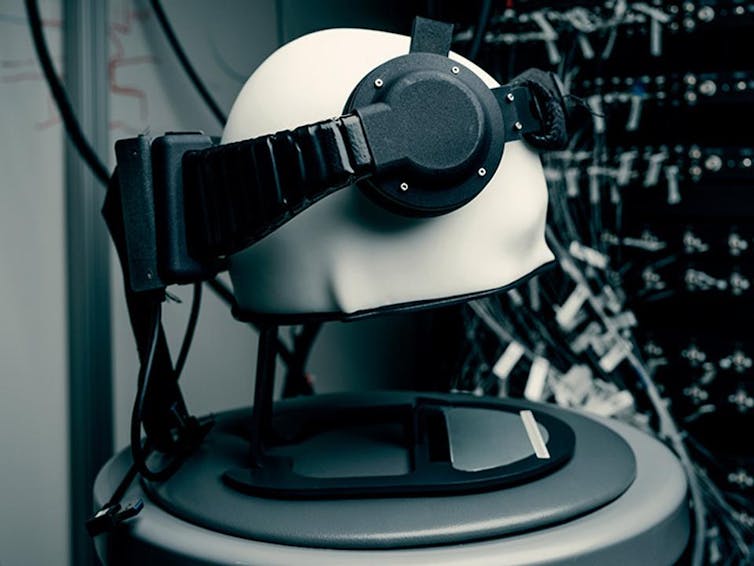
Facebook’s prototype brainwave-reading device.
Facebook

If mind-reading devices become the normal way to interact with computers, we may end up with little choice but to use them in order to keep up with more productive colleagues. (Imagine someone today applying for an office job but refusing to use email.) And if Neuralink-style implants become the norm, this could also lead to greater inequality determined by what level of kit you could afford to have installed.

Elon Musk has stated that the enormous loan required to afford Neuralink surgery would be offset by potential earnings for the “enhanced”. The idea of people feeling pressured to take on huge debts to have surgery just to keep their job comes straight from a sci-fi dystopia.

On top of all this is the more direct physical threat of having systems physically intruding on our brains. While some people may want to modify their brain with a computer interface (there are already plenty of experimental biohackers), to roll this out on a large scale would require massive and thorough testing.

Given Silicon Valley’s reputation (and penchant) for breaking things rather than stopping to think them through, these systems will need close regulation and ethical review even before testing begins. Otherwise it risks creating mutilated human guinea pigs.

For all this, there could be huge advantages to continuing research in this area, particularly for those suffering from paralysis or sensory impairment. But Silicon Valley should not be able to dictate the way these technologies are developed and deployed. If they do, it may radically reshape the way we identify as human.The Conversation

Garfield Benjamin, Postdoctoral Researcher, School of Media Arts and Technology, Solent University

This article is republished from The Conversation under a Creative Commons license. Read the original article.

Brain computer-interface EEG Elon Musk Facebook Silicon Valley
Share. Facebook Twitter Pinterest LinkedIn Tumblr Email
Contributor

Related Posts

Private Credit Rating Agencies Shape Africa’s Access To Debt. Better Oversight Is Needed

2026-02-03

Why South Africa Cannot Afford To Wait For Healthcare Reform

2026-02-02

SA Auto Industry At Crossroads: Cheap Imports Threaten Future

2026-02-02

Stablecoins: The Quiet Revolution South Africa Can’t Ignore

2026-02-02

South Africa Could Unlock SME Growth By Exploiting AI’s Potential Through Corporate ESD Funds

2026-01-28

How Local Leaders Can Shift Their Trajectory In 2026

2026-01-23

Why Legal Businesses Must Lead Digital Transformation Rather Than Chase It

2026-01-23

Directing The Dual Workforce In The Age of AI Agents

2026-01-22

The Productivity Myth That’s Costing South Africa Talent

2026-01-21
Leave A Reply Cancel Reply

DON'T MISS
Breaking News

Digitap ($TAP) Crushes NexChain with Real Banking Utility: Best Crypto to Buy in 2026

The crypto presale market in 2026 has seen dozens of projects compete for investor attention.…

Dutch Entrepreneurial Development Bank FMO Invests R340M In Lula To Expand SME funding In SA

2026-02-03

Paarl Mall Gets R270M Mega Upgrade

2026-02-02

Huawei Says The Next Wave Of Infrastructure Investment Must Include People, Not Only Platforms

2026-01-21
Stay In Touch
  • Facebook
  • Twitter
  • YouTube
  • LinkedIn
OUR PICKS

Vodacom Reports Robust Q3 Growth, Driven By Diversification And Strategic Moves

2026-02-04

South Africa’s First Institutional Rand Stablecoin, ZARU, Launches

2026-02-03

The EX60 Cross Country: Built For The “Go Anywhere” Attitude

2026-01-23

Mettus Launches Splendi App To Help Young South Africans Manage Their Credit Health

2026-01-22

Subscribe to Updates

Get the latest tech news from TechFinancials about telecoms, fintech and connected life.

About Us

TechFinancials delivers in-depth analysis of tech, digital revolution, fintech, e-commerce, digital banking and breaking tech news.

Facebook X (Twitter) Instagram YouTube LinkedIn WhatsApp Reddit RSS
Our Picks

Digitap ($TAP) Crushes NexChain with Real Banking Utility: Best Crypto to Buy in 2026

2026-02-07

Football Fans Can Share Their ‘Super Bowl Spread’  With The Chance To Win an NFL Jersey

2026-02-07

Why Traditional Banks Need Mobile Money Solutions to Survive the Next 5 Years

2026-02-07
Recent Posts
  • Digitap ($TAP) Crushes NexChain with Real Banking Utility: Best Crypto to Buy in 2026
  • Football Fans Can Share Their ‘Super Bowl Spread’  With The Chance To Win an NFL Jersey
  • Why Traditional Banks Need Mobile Money Solutions to Survive the Next 5 Years
  • Spotify Brings Audiobooks to South Africa
  • Anjouan Corporate Services Reshapes Cross-Border Brokerage Licensing Strategy for UAE-Focused Firms
TechFinancials
RSS Facebook X (Twitter) LinkedIn YouTube WhatsApp
  • Homepage
  • Newsletter
  • Contact
  • Advertise
  • Privacy Policy
  • About
© 2026 TechFinancials. Designed by TFS Media. TechFinancials brings you trusted, around-the-clock news on African tech, crypto, and finance. Our goal is to keep you informed in this fast-moving digital world. Now, the serious part (please read this): Trading is Risky: Buying and selling things like cryptocurrencies and CFDs is very risky. Because of leverage, you can lose your money much faster than you might expect. We Are Not Advisors: We are a news website. We do not provide investment, legal, or financial advice. Our content is for information and education only. Do Your Own Research: Never rely on a single source. Always conduct your own research before making any financial decision. A link to another company is not our stamp of approval. You Are Responsible: Your investments are your own. You could lose some or all of your money. Past performance does not predict future results. In short: We report the news. You make the decisions, and you take the risks. Please be careful.

Type above and press Enter to search. Press Esc to cancel.

Ad Blocker Enabled!
Ad Blocker Enabled!
Our website is made possible by displaying online advertisements to our visitors. Please support us by disabling your Ad Blocker.