


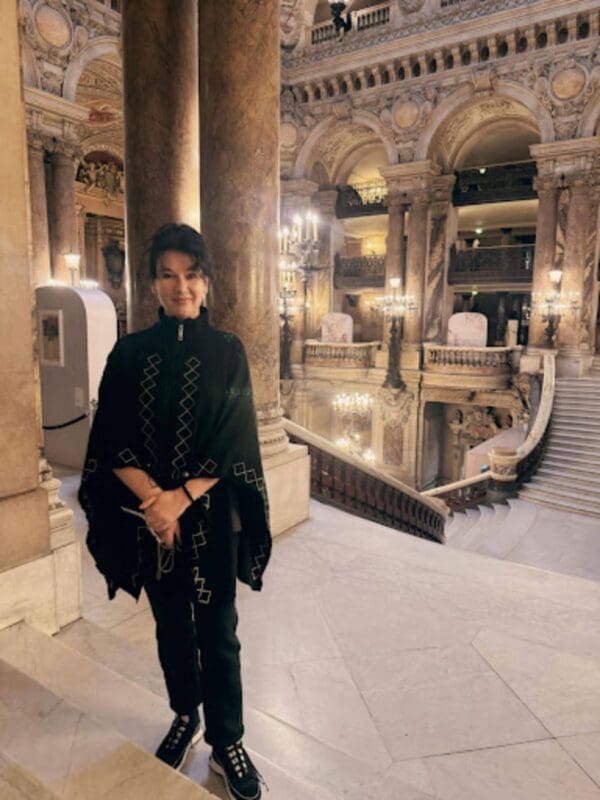

Larissa Saveliev (Photo Ming Qin @littlecorgi_studio)
The founder of Youth America Grand Prix has transformed a simple idea into the world’s largest student ballet scholarship audition, connecting young dancers with opportunities around the globe.
For Larissa Saveliev, a typical workweek might involve stops in Australia, Singapore, Japan, London, and Paris. As founder and artistic director of Youth America Grand Prix (YAGP), the world’s largest student ballet scholarship audition, she spends much of her year traveling between continents, discovering talent and connecting aspiring dancers with the institutions that could change their lives.
The schedule can be exhausting. Recently, Saveliev and her husband, Gennadi, planned a vacation, booking flights and a hotel before reconsidering. “We both just looked at each other and said, ‘Do you want to fly?’” she recalls. “And he’s like, ‘No,’ and we canceled it.”
After more than 26 years building YAGP into an international dance institution, staying home has become a luxury. But Saveliev has no intention of slowing down. “I love what I do,” she says.
From Moscow to a Global Movement
Born in Moscow, Saveliev trained at the prestigious Bolshoi Ballet Academy and performed with the Stanislavsky Ballet and Bolshoi Ballet before emigrating to the United States in 1994.
Her husband joined American Ballet Theatre, while Saveliev, raising their young child, began teaching at a local dance studio. It was there that she noticed something missing from American ballet education. “I started looking for information,” she recalls. “Where can I meet other young ballet teachers? Where can I share ideas? Where can I learn as a teacher?” She discovered few opportunities for students and teachers to connect with the broader professional ballet community.
Raised by two university professors, Saveliev understood the importance of education. She envisioned an organization that would combine dance training, mentorship, and access to prestigious schools.
In 1999, she and Gennadi founded Youth America Grand Prix. The concept was straightforward: talented young dancers would compete not simply for trophies, but for scholarships and professional opportunities. The organization quickly expanded, helping establish a model that other dance competitions would follow. “We were the pioneers,” Saveliev says. “I was not sure exactly what I was doing. We were trial by fire because we didn’t really have anybody to follow.”
Opening Doors Worldwide
Today, the New York-based nonprofit reaches more than 15,000 students annually through auditions, workshops, and master classes across more than 30 American cities and 15 international locations. Its annual Season Finals bring together more than 1,500 promising dancers, along with directors from leading ballet schools and companies.
Saveliev compares the process to professional sports recruitment. “Imagine an NHL draft,” she says. “They come from different countries, different places, different backgrounds, and they come in one place.”
Over its history, YAGP has reached more than 300,000 dancers and awarded more than $5 million in scholarships. More than 500 alumni now perform with 100 companies worldwide, including American Ballet Theatre, New York City Ballet, Paris Opera Ballet, and The Royal Ballet.
For Saveliev, ensuring financial accessibility for young dancers remains essential. Becoming a professional dancer requires extraordinary physical ability, athleticism, artistry, and years of expensive training. “You have to be an amazing actor, an amazing athlete, with very strict physical demands,” she says. Even pointe shoes can cost approximately $100 per pair. “While dancers bring their own unique abilities and potential, we can help ensure they have access to the training, education, financial support, and opportunities they need to succeed.”
Beyond the Competition
YAGP’s mission now extends well beyond scholarship auditions. A recent collaboration with Jacob’s Pillow in Massachusetts featured performances highlighting emerging choreographers, supported by a $1 million fellowship established through philanthropist Marcella Hymowitz.
The organization is also expanding partnerships with European festivals, including Italy’s Ravenna Festival, bringing music and dance together. Another milestone is its annual New York City gala, “Stars of Today Meet the Stars of Tomorrow,” traditionally held at the Lincoln Center and moving this year to Jazz at Lincoln Center’s Rose Theater. YAGP has also welcomed the prestigious School of American Ballet into its network of collaborating institutions. Yet Saveliev believes the organization’s greatest contribution extends beyond producing professional dancers.
Creating Tomorrow’s Audiences
Only a small percentage of young dancers will ultimately pursue professional careers. Saveliev hopes the others become lifelong supporters of ballet. “What we’re really hoping for is that out of 10,000 dancers auditioning in the U.S., the other 9,000 become ballet lovers,” she says. Some may become choreographers, photographers, physical therapists, or critics. Others may simply attend performances with their families.
With ballet competing against social media and countless entertainment options, developing younger audiences has become increasingly important. “We’re trying to nurture that and give them this bug that will stay with them for the rest of their lives,” she says.
For Saveliev, success isn’t measured solely by scholarships awarded or careers launched. It is also about ensuring the future of ballet, so it continues to inspire generations to come.
For more information about Youth America Grand Prix, visit yagp.org
