


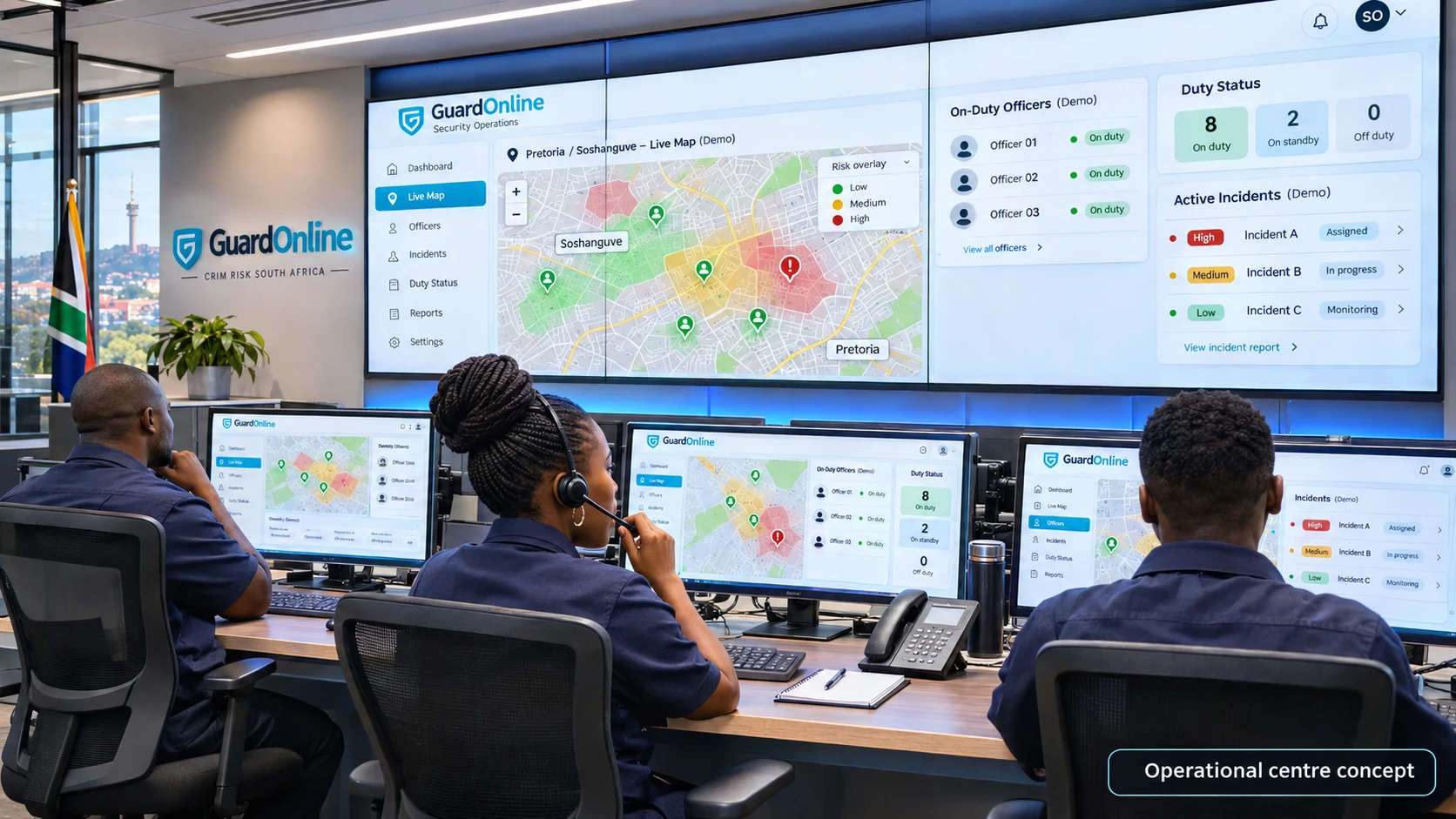

A security officer who was held at gunpoint, shot and robbed of his cellphone and vehicle while on duty in Soshanguve on Friday, 13 November, has survived the attack, while a South African-developed security technology reportedly helped recover the hijacked vehicle in less than 20 minutes.
What makes the recovery remarkable is that the hijacked vehicle was not fitted with a vehicle-tracking device.
Instead, a technology platform known as GuardOnline, developed by Crim Risk South Africa, was used to obtain location intelligence linked to the security officer’s stolen cellphone, assisting a reaction team in locating and recovering the vehicle.
The injured officer, employed by Intellisense Protection Services (IPS), was transported to hospital following the shooting. His injuries were not fatal, and he is recovering.
A routine security deployment turns violent
According to information, the officer was carrying out his security duties when he was confronted by armed criminals.
The attackers held him at gunpoint, robbed him of his cellphone and hijacked the vehicle he was driving. During the incident, the officer sustained a gunshot wound.
With the vehicle having no dedicated tracking device, recovering it through conventional vehicle-tracking systems was not an option.
However, the security company was participating in a trial of GuardOnline, a digital security management platform that enables companies to monitor security officers deployed across different locations.
Following the robbery, the technology was accessed to obtain location information associated with the stolen cellphone.
IPS deployed its own reaction team, which used the available intelligence to assist its response. The hijacked vehicle was recovered in less than 20 minutes.
The incident demonstrates the potential value of connecting frontline security personnel with technology-enabled operations.
Technology being trialled in VumaCam-linked security operations
At the time of the incident, IPS was providing security services under an arrangement involving Centre, an operations business described by those involved in the trial as being owned by VumaCam.
VumaCam is known for its extensive network of surveillance cameras and technology platforms used by private security companies and public-sector crime-fighting partners.
The GuardOnline technology was being trialled through Centre’s operations platform as part of efforts to improve oversight of security officers deployed to protect and service fibre-network infrastructure.
The objective of the trial is to provide security operators with better visibility of personnel on duty, their deployment locations, operational activities and the potential risks associated with their surroundings.
Friday’s incident presented an unexpected real-world test of the technology’s operational value.
Early warning intelligence before the robbery
An important feature of GuardOnline is its ability to combine the geolocation of security personnel with crime-risk intelligence.
Information displayed on the platform identified the deployment environment as a crime hotspot, with indicators relating to robbery, hijacking and other serious crimes.
This raises a significant question about the role of preventative intelligence in private security.
Could the danger to the officer have been reduced if the available crime-risk information had informed additional precautions before the attack?
Such precautions could include heightened vigilance, changes to patrol arrangements, additional backup or increased monitoring of officers operating in higher-risk areas.
There is no confirmed evidence that any particular intervention would have prevented Friday’s robbery. Nevertheless, the incident highlights the importance of converting early-warning intelligence into operational decisions.
Artificial intelligence meets frontline security
GuardOnline was developed by Crim Risk South Africa to modernise the way private security companies manage personnel and operational information.
The platform combines GPS-enabled location reporting, digital duty management, incident reporting, crime intelligence and artificial intelligence-assisted analysis.
Security officers can register for duty through their mobile phones, submit geolocated reports and provide operational updates that feed into a central management platform.
The technology allows authorised control-room personnel to identify deployed officers, monitor reporting activity and access information that can assist security decisions.
AI-assisted functions help analyse recorded observations, identify patterns, flag areas of concern and organise information for security managers.
The system is designed to give security companies greater operational visibility while improving coordination between officers, supervisors and reaction teams.
The Soshanguve incident illustrates how location information collected during normal security operations can become valuable when an emergency occurs.

Response time can make the difference
The recovery also highlights the importance of having an operational reaction capability behind the technology.
GuardOnline did not physically recover the vehicle. That responsibility fell to IPS Security’s reaction personnel.
The technology contributed location information, while the security company’s reaction team carried out the physical response and recovery.
This distinction is significant.
Modern security operations increasingly depend on more than surveillance cameras, armed personnel or tracking devices operating independently. Their effectiveness depends on how quickly information reaches decision-makers and how efficiently responders act on it.
In the Soshanguve case, the combination of location intelligence and an available reaction team contributed to the reported recovery of a hijacked vehicle in less than 20 minutes.
The precise dispatch, arrival and recovery timestamps have not yet been independently confirmed.
A potential shift in private security operations
South Africa’s private security industry faces continuing pressure to improve officer safety, protect infrastructure and respond effectively to violent crime.
For security companies responsible for telecommunications networks, construction sites, residential developments and other dispersed infrastructure, maintaining visibility over mobile personnel presents an operational challenge.
GuardOnline’s approach is to turn the mobile devices already used by security officers into tools for structured reporting, deployment visibility and operational intelligence.
The Soshanguve recovery offers an example of how this approach can support an emergency response even when a stolen vehicle has no dedicated tracker.
For the injured officer, the priority remains his recovery.
For the security industry, Friday’s events raise a broader question: How much more effective could frontline security become if crime intelligence, personnel monitoring and reaction capabilities operated as one connected system?
The recovery may have taken less than 20 minutes, but its implications for technology-supported security operations could extend well beyond the incident.
