



As federal courts prepare to issue landmark rulings on artificial intelligence and copyright following major multi-billion-dollar legal disputes, the technology industry faces a crucial crossroads. Frontier AI models have historically relied on absorbing vast amounts of human expertise without clear attribution or direct compensation, creating friction between creators and AI developers.
Professional Language Models, Inc. aims to address this imbalance with the launch of the PLM Network and the Decentralized Intelligence Economy. In this Executive Q&A, we speak with Philip Bridgeman, Co-Founder and Chief Innovation Officer at PLM, Inc., about how their system registers expert knowledge as owned digital property, routes query-based royalties back to creators, and powers “Collaborative Superintelligence” alongside frontier AI engines.
Q: The AI industry is currently navigating intense scrutiny over intellectual property and copyright compliance. How does the PLM Network serve as a digital clearinghouse to address this compensation gap?
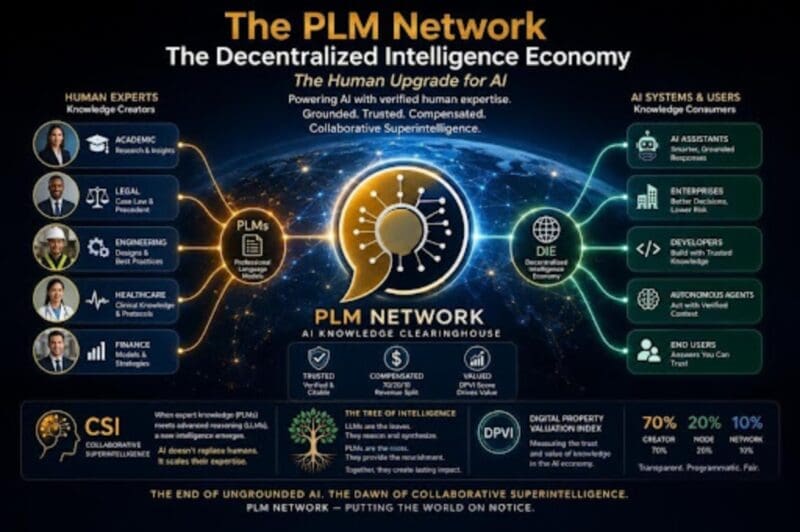
Philip Bridgeman: The PLM Network is designed as an agent-first platform that fundamentally changes how expertise is accessed and compensated. We allow users to tap into our experts’ intellectual property through either subscription-based or per-query models. When a query is submitted to the PLM Network, our system searches through the relevant Professional Language Models (PLMs) and selects the best possible PLM using our proprietary DPVI rating system. The chosen PLM is queried, the response is returned, the query is recorded, and the customer is charged. The groundbreaking part is that these funds are deposited directly into the PLM owner’s digital wallet on the PLMMarket. This means that Large Language Models (LLMs) can connect to the PLM Network, route queries requiring specialized human input to the appropriate PLM, and ensure that the creators are properly compensated for their knowledge in real time.
Q: You often draw a comparison between the PLM Network and performance rights organizations like BMI or ASCAP in the music industry. How does an expert earn a royalty when an AI system queries their knowledge base?
Philip Bridgeman: Just as Performance Rights Organizations (PROs) collect fees from radio stations and clubs for playing an artist’s music, the PLM Network operates on a similar principle for knowledge. We charge corporate entities a volume-based fee for general access to our network. Those proceeds are then distributed to the queried PLM owners based on the number of recorded queries their models fulfill. This innovative concept—which actually caught the attention of Hip-Hop Artist AZ—solves a critical problem: it enables AI systems to fairly compensate human creators while maintaining the high effectiveness and speed that users expect from artificial intelligence.
Q: The system centers on a new asset class called a Professional Language Model (PLM). How does a PLM differ from traditional AI models that absorb training data into their weights?
Philip Bridgeman: Traditional AI models absorb vast amounts of data into their weights, often losing the connection to the original creator. In contrast, a PLM is a specialized dataset that comes directly from the human experts who created the content. The key differentiator is provenance. When a PLM is queried, you know exactly whose expertise you are accessing and where the information originated. This knowledge is stored in our database as vectors, allowing it to be queried seamlessly and efficiently, just like traditional AI platforms, but with full attribution and transparency
Q: In describing the architecture of Collaborative Superintelligence, you use the “Tree of Intelligence” analogy. How do human experts function as the “root system” alongside frontier models like OpenAI or Google?
Philip Bridgeman: In our “Tree of Intelligence” analogy, each individual expert’s PLM serves as a foundational root. These roots draw up the deep, specialized knowledge required for complex problem-solving. The trunk of the tree is the PLM Network itself, which channels incoming queries from users. These queries flow through various branches and ultimately reach the leaves, which represent the LLM interfaces (like OpenAI or Google) that users interact with. This architecture ensures that frontier models are constantly fed with verified, expert-driven insights from the roots, creating a true Collaborative Superintelligence.
Q: PLM, Inc. has already made its core infrastructure operational, including an AI agent named Sqwibbl. How does Sqwibbl interact with verified expert knowledge in real time while navigating desktop environments?
Philip Bridgeman: The Sqwibbl is a Computer Use AI Agent designed to work on a windows desktop and capable of running Windows based software. It is also designed to work hand in hand on the PLM Network to pull information directly from PLMs that can be used in software packages operating on your desktop. In fact if you have a software package with its user manual converted to a PLM on the PLM Network then your Sqwibbl can operate that software package effectively as a veteran user from day one. PLMMarket.com is an Agentic website; it has an MCP server and an API system designed to work with AI Agents. Every agent that registers at the PLMMarket receives its own crypto wallet and can conduct transactions on the PLM network to purchase subscriptions to PLMs.
Q: Looking ahead, how do you see the Decentralized Intelligence Economy transforming how professionals structure, license, and monetize their proprietary insights over the next five years?
Philip Bridgeman: We are entering the Agentic Era, where the primary end-user for any website will be a person’s AI agent rather than a human browsing manually. Over the next five years, we anticipate that all professionals will require their own Personal PLM Node. This node will consist of an agent like Sqwibbl, hosted on a cloud-based Windows server, and governed by a unique set of PLMs owned by that individual. This setup will allow professionals to seamlessly structure, license, and monetize their proprietary insights in a decentralized economy. The PLM Network is positioned at the very center of this transformation, empowering creators to thrive in an AI-driven future.
The emergence of structured knowledge networks offers a viable path forward for the ongoing debate surrounding AI and intellectual property. By shifting from uncompensated web scraping to transparent, query-based micropayments, creators can retain ownership of their expertise while contributing directly to advanced AI systems.
As frontier reasoning engines become more integrated into commercial workflows, the need for verified, grounded human knowledge will only grow. Establishing open clearinghouses that connect real-world expertise to digital infrastructure ensures that the human foundation of artificial intelligence remains protected, cited, and fairly rewarded.
To learn more, visit https://plmmarket.com/
