


Choosing the best executive search firm for a CTO hire starts with hard data. In Q2 2026, 263 mega-rounds absorbed 81 percent of global venture funding, while total deal count fell to a ten-year low, CB Insights reports. At the same time, only 44 percent of CEOs say their CIOs are truly AI-savvy, according to Gartner. Capital is concentrated, AI talent is scarce, and a mis-hire burns both.
We solved the noise problem. Our team scored dozens of firms on technical depth, stage fit, evidence transparency, partner time, diversity, global reach and proprietary tools – flagging each metric as independent, self-reported or undisclosed. Seven firms cleared the bar; your job is to match the next 18 months of strategy to the partner who has already solved that exact problem.
How we evaluated the best CTO executive search firms
Before naming a single firm, we scored each contender against evidence you can verify, not marketing copy.
Our seven-factor scoring model
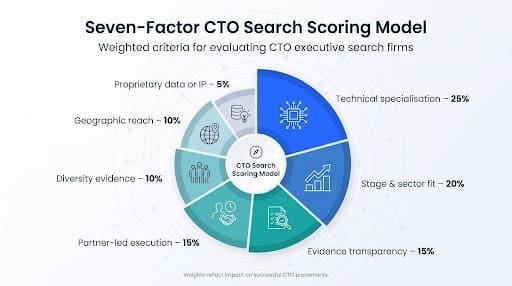
We weighted the criteria below to reflect the real stakes of a CTO hire:
- Technical specialisation (25 percent). Recent CTO, engineering, AI or security mandates that prove deep domain skill.
- Stage and sector fit (20 percent). Placements that mirror the company’s journey (seed, scale-up, PE-backed or public) and its industry.
- Evidence transparency (15 percent). Named placements, time-to-close metrics and clear “independent vs. self-reported” labels.
- Partner-led execution (15 percent). The lead partner’s personal track record and pledged weekly hours on the search.
- Diversity evidence (10 percent). Published pool, shortlist and placement data, not just policy PDFs.
- Geographic reach (10 percent). Ability to map talent across the United States, EMEA and Africa when required.
- Proprietary data or IP (5 percent). Tools that improve accuracy, not simply speed.
To keep large balance sheets from hiding thin tech chops, we cross-checked public claims against client news releases, regulatory filings and Hunt Scanlon’s 2026 revenue tables.
A firm advanced only if it:
- showed a recent, named CTO placement,
- assigned a clear lead partner,
- matched our target stage, and
- carried zero unresolved red flags.
Only seven firms cleared that bar, and they appear next in the lane where they outperform.
Quick comparison of CTO executive search firms
Need a board-speed view before the deep dive? The table below condenses our seven-factor scores into one glance, showing where each firm excels and where extra diligence could help.
| Firm | Best for | Stage focus | Core strengths | Model | Public timeline* | Global reach | Fit score |
| SPMB | Growth-stage innovators | Startup to public | AI, software, security | Retained | 60–90 days (SR) | US-led | 86 |
| Daversa Partners | Founder-led startups | Seed to Series C | Venture network, equity closes | Retained | ND | US + international placements | 82 |
| Riviera Partners | Product and data leadership | Seed to public | SutroX data platform | Retained | ND | US / EMEA | 91 |
| True Search | PE and cross-border scale-ups | Series B to enterprise | Six-continent reach, AI index | Retained | ND | Global | 88 |
| JM Search | PE-backed transformation | Series C to IPO | Operator partners, NPS 78 | Retained | ND | US hubs | 84 |
| Korn Ferry | Global enterprises | Large public and regulated | Assessment suite, Johannesburg office | Retained + advisory | ND | Global | 83 |
| Heidrick & Struggles | Industrial and public change-agents | Enterprise | Cyber, semis, board work | Retained + advisory | ND | Global | 82 |
*Timeline legend: (SR) = self-reported; ND = not disclosed publicly. We found no independent timeline data for ND entries in 2026 filings or Hunt Scanlon reports.
Use the matrix to line up your mandate. For instance, a seed-stage fintech in Johannesburg may lean on Daversa’s founder playbook or Riviera’s product depth, while a listed industrial overhaul often benefits from Korn Ferry’s on-ground Africa presence or Heidrick’s board-grade governance support.
The next sections unpack why each score looks the way it does, so you can press partners on the numbers that matter.
1. SPMB Executive Search: best for growth-stage technology and AI companies
Why SPMB sits on a growth-stage shortlist
SPMB Executive Search definitive guide page screenshot
When you leap from product-market fit to hundreds of engineers, you cannot wait nine months for a CTO. SPMB focuses on that window, and its new Definitive Guide to the best executive search firms for CTO hiring pegs a partner-led CTO search at 60-90 days from kickoff to signed offer, fast by C-suite standards. The Silicon Valley firm has filled senior technology roles for venture-backed and public brands since 1977.
Where SPMB adds real lift
Partners frame every mandate around three archetypes (Architect, Scaler, Strategic Operator) so founders hire the profile they need next, not a résumé trophy. Deep benches in AI, data and cybersecurity make SPMB a strong fit for software teams rushing to ship machine-learning products. Weekly market-map updates come from the named partner, keeping you close to real outreach rather than static lists.
Questions to lock down before signing
- Confirm international reach: With three US offices, how will the team cover Berlin or Bangalore if the slate points overseas?
- Request diversity proof: The firm publishes policy-level figures only; ask for CTO-specific long-list, short-list and placement data.
- Verify timeline reality: The 60–90-day estimate is self-reported; request the last three searches that met that mark.
Get clear answers, and SPMB offers growth-stage leaders a fast, focused path to a high-impact technology chief.
*Timeline source: SPMB’s Definitive Guide to CTO Executive Search (self-reported).
2. Daversa Partners: best for founder-led and venture-backed startups
Why Daversa shows up on founder cap tables
Seed to Series C boards need a partner who speaks term sheets as fluently as tech stacks. Nearly every Daversa assignment sits inside a venture portfolio, so offer design, equity splits and board politics feel familiar.
What makes Daversa different
- Narrative fit over résumé gloss. Partners coach founders to pitch the mission, then surface candidates who amplify that story.
- Venture-network mapping. Nearly all of its work sits inside venture portfolios, so ask how the firm maps that landscape and what data surfaces rising engineering leaders before they flood recruiter inboxes (Daversa Partners).
- Diversity reporting. Ask which pool, short-list and placement metrics you will receive and how often; the firm publishes no standard cadence, so pin it down in the engagement letter.
Three questions to insist on
- Which partner will lead the search, and how many CTOs has that person placed in the past 24 months?
- What was the median time from kickoff to founder-stage CTO searches last year?
- Which competitors sit behind the off-limits wall?
Get crisp answers, and Daversa becomes a high-conviction pick for startups chasing their first true technology chief.
3. Riviera Partners: best for product, engineering, AI and data leadership
Why product-first teams turn to Riviera
Riviera Partners technology executive search homepage screenshot
Riviera is a pure-play technology search firm. Every retained brief targets product, engineering, data or security leadership, so you never compete with CFO or CHRO mandates. That focus shows up in the numbers: on Hunt Scanlon’s 2026 list, Riviera’s Americas revenue rose 59 percent year over year, and the firm reports placements in 20-plus countries (SR).
The SutroX data edge
Instead of a static database, Riviera built SutroX, a platform that fuses two decades of search history with live market intelligence. It ranks candidates by technical depth, leadership scope and scaling experience, lifting “staff-engineer-turned-CTO” profiles that generic lists miss. Clients say the tool cuts outreach time and, more importantly, improves match quality; Riviera reports that 60 percent of its assignments come from repeat clients (SR).
Diligence questions to ask
- How is the 60 percent repeat metric calculated (by revenue or by search count, and over what period)?
- Which partner, not a researcher, will run your search, and how many hours per week are committed?
- How does SutroX score diversity to avoid algorithmic blind spots?
Get clear answers, and Riviera offers seed-through-public companies a data-powered route to their next technology chief.
4. True Search: best for PE-backed scale-ups and cross-border mandates
Why private-equity boards shortlist True
Speed and governance rarely coexist, yet True delivers both. Hunt Scanlon’s 2026 table lists USD 333 million in Americas fees, up 17 percent year over year, with searches conducted on six continents.
When data becomes a second partner
True’s AI Capability Index scores executives on their record of machine-learning and data-driven transformation. Integrated into the firm’s Thrive TRM platform, the index gives clients a real-time dashboard of outreach, funnel diversity and interview feedback. Weekly visibility aligns with value-creation plans that expect a new CTO to lift ARR or trim cloud spend inside 12 months.
Cross-border reach without excess overhead
With focused teams across the Americas, EMEA and APAC, True says it covers 50-plus countries (self-reported) through one contract and one accountable partner, avoiding the coordination drag of affiliate networks.
Questions to lock in success
- Which partner owns the file, and what weekly time is guaranteed once the search is live?
- How does the AI Capability Index adjust for sector nuance (fintech risk versus hard-tech depth)?
- What off-limits rules apply across True’s global office network?
Secure clear answers, and True gives PE and growth investors a data-driven route to senior technology leadership on both sides of the Atlantic.
5. JM Search: best for PE-backed mid-market transformation
Why portfolio operators keep JM on speed dial
Private-equity playbooks move fast. Value-creation plans start 30 days after close, and the technology leader sets the tempo. JM focuses on that mid-market zone (roughly USD 100 million to USD 1 billion in revenue) where a company has outgrown startup tactics but has not yet built enterprise layers. Many partners are former CEOs, CFOs or CTOs, so investor targets translate into specs candidates respect.
Operator insight, not just recruiter reach
Ex-operators review architecture debt, cloud spend and cybersecurity posture before drafting a brief, avoiding “paper-fit” hires who falter once hold-period metrics arrive. JM also publishes a client Net Promoter Score of 78 (SR) and recorded 21.8 percent Americas revenue growth in 2025, proof that the model resonates with sponsors and management teams.
Checklist for a no-surprise engagement
- Request the last three CTO searches closed for companies between USD 100 million and USD 1 billion.
- Confirm that the operating partner who pitches will lead interviews after the deal team departs.
- Ask how diversity is measured at each funnel stage; PE boards now want hard numbers, not promises.
When those answers align, JM gives PE owners a partner fluent in both EBITDA and Kubernetes – and ready to deliver results on both.
6. Korn Ferry: best for global enterprises and African reach
Why multinationals default to Korn Ferry
Few firms can satisfy boards in Johannesburg, London and New York with one process. Hunt Scanlon’s 2026 list shows Korn Ferry leading the field with USD 1.645 billion in Americas search fees and 470 consultants across 37 Americas offices, part of a network spanning more than 50 countries.
Enterprise-grade breadth
The Digital and Technology Officers practice covers CIO, CTO and CISO roles, then layers in org design, compensation and succession advice. If you need a data point on AI-leader pay in Nairobi, the firm’s Talent Suite, fuelled by millions of profile and compensation records, delivers it.
A real foothold in Africa
Unlike tech boutiques that fly teams from Europe, Korn Ferry runs a staffed Johannesburg office that handles day-to-day candidate outreach, reference checks and relocation logistics.
Watch-outs before you sign
- Off-limits: a vast client roster can block key targets; ask for a written list.
- Partner time: insist the named partner, not a project manager, runs key interviews.
- Fees: clarify how assessment or onboarding modules add to the retained search to avoid scope creep.
Get those details in writing, and Korn Ferry delivers Fortune 500 process, deep data and genuine African coverage in one package.
7. Heidrick & Struggles: best for public, industrial and regulated transformation
Why listed boards call Heidrick first
Semiconductor fabs, defense suppliers and critical-infrastructure providers face regulators, investors and customers at once. Heidrick’s Technology & Services practice covers AI, cybersecurity, digital infrastructure and software, then connects to the firm’s board and CEO succession benches. Directors can test a CTO’s governance skill as well as architecture depth.
Breadth without dilution
Hunt Scanlon lists 218 consultants across 21 Americas offices (2026). That scale supports cross-border slates, yet searches stay partner led. Heidrick’s leadership-assessment platform scores behavioral competencies alongside technical depth, showing whether a finalist can brief audit committees instead of just running sprints.
Key diligence points
- Off-limits: request a written list of peer companies behind the conflict wall.
- Fees: Heidrick’s advisory arms add value but cost, so clarify what is bundled.
- Partner time: confirm the named partner, not a project manager, conducts final interviews.
Line up those details, and you get one global doorway to talent that satisfies shareholders, regulators and engineers in a single move.
Stage fit vs big-tech pedigree: what predicts CTO success
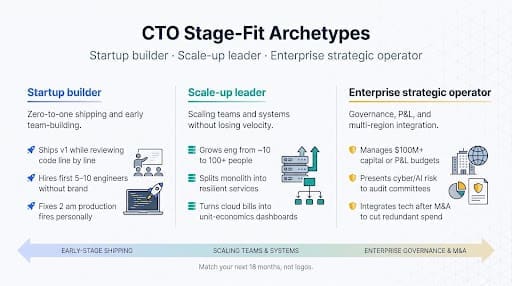
Brand logos do not build products. Matching a leader to your next stage does. The core signal is simple: has the candidate already crossed the same gap your company now faces?
Startup builder
At zero to one, success is clear: ship and sell before the runway ends. Look for a CTO who has:
- Shipped a v1 feature set while still reviewing code line by line.
- Hired the first 5–10 engineers without big-company brand or comp.
- Chosen an architecture that trades speed for manageable technical debt.
- Closed early investors and design-partner customers in plain language.
- Fixed a 2 am production fire personally because no SRE team existed.
If a candidate cannot show at least three of these moments, you are meeting a manager, not a builder.
Scale-up leader
After Series B, code yields to scale. Strong scale-up CTOs show that they have:
- Grown engineering from about 10 to 100+ people while keeping release cadence.
- Split a monolith into services that survive traffic spikes and midnight deploys.
- Introduced reliability, security and data governance without killing velocity.
- Turned cloud bills and tech debt into board-ready unit-economics dashboards.
- Hired VPs who outgrew the founder crew, then stepped back so they could lead.
Ask finalists to whiteboard how they would double throughput in 12 months, including org chart, metrics and milestones.
Enterprise strategic operator
Public or regulated firms add governance to growth. The shortlist should surface CTOs who have:
- Managed capital or P&L budgets of USD 100 million+.
- Presented cyber-risk or AI-ethics roadmaps to audit committees.
- Led multi-region teams across at least three time zones and kept overhead flat.
- Integrated tech stacks after M&A, eliminating redundant spend.
- Balanced innovation with uptime SLAs that keep regulators and investors calm.
Request a one-page board brief they wrote in the past year; the best candidates translate latency or zero-day risk into share-price language.
Retained vs contingency CTO search
Why retained rules the C-suite
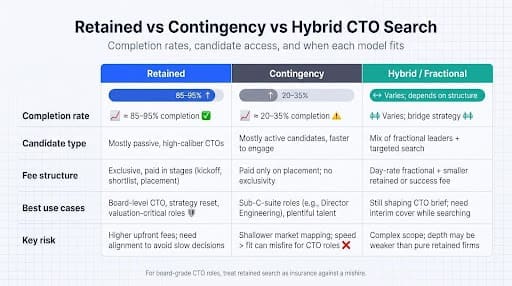
Retained search works like an extension of the board: you grant exclusivity, pay in stages and receive a full-market map of mostly passive candidates. Partners handle structured interviews, deep references and compensation negotiations under strict confidentiality, which is critical when rumors of change can unsettle staff or investors. According to industry analysis, retained searches complete about 71 percent of the time on average, with AESC-tier boutiques reported at the top of an 85 to 95 percent band, while contingency firms often deliver success rates between 20 and 35 percent. For a mission-critical CTO, that extra certainty outweighs the higher fee.
When contingency can suffice
Contingency recruiters are paid only on placement, so they prioritize speed and active candidates. This model can work when:
- The role sits below the C-suite (for example, Director Engineering).
- Qualified talent is plentiful and easy to spot.
- Closing fast matters more than mapping every passive prospect.
It rarely surfaces a board-grade CTO who must reset strategy, culture and compliance in one move.
Hybrid or fractional as a bridge
Still shaping the brief? A fractional CTO on a day rate can keep the code shipping while a retained firm conducts the wider market search. Mixed-model boutiques offer that flexibility, usually with less market coverage than a full retained process.
Bottom line: if the role touches the board and shapes valuation, budget for retained and treat the fee as insurance against a mishire, not a surcharge on success.
What does CTO executive search cost?
The classic formula
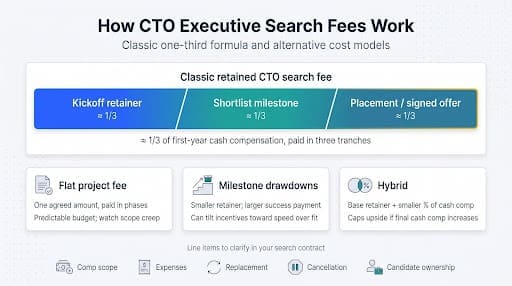
Retained firms have long charged about one-third of first-year cash compensation, payable in three tranches (kickoff, shortlist, placement). Equity is usually excluded, but confirm up front; some boutiques peg fees to total target comp, not just salary plus bonus.
Fixed and milestone models
Market pressure has produced alternatives:
- Flat project fee. One number agreed at signature, paid in phases. Good for budgeting, but watch scope creep (extra geographies or assessments).
- Milestone drawdowns. Smaller initial retainer and a larger success payment at signed offer; this structure can tilt behavior toward speed over fit.
- Hybrid. Base retainer plus a smaller percentage of cash comp, capping upside if the candidate negotiates a richer deal.
Five line-item questions to protect your budget
- Does “compensation” include sign-on, relocation or guaranteed bonus?
- Are researcher expenses billed at cost or with margin?
- How long is the replacement guarantee, and is the redo fee-free or discounted?
- If you cancel mid-search, what portion of unearned fees is refundable?
- Who owns candidates introduced during the engagement if you hire them later for a different role?
Get those answers in writing before kickoff. Clarity keeps everyone focused on value creation, not billing disputes.
Emerging CTO hiring trends to watch
AI-native vs. AI-enabled leadership
Generative AI has split the market in two:
- AI-native CTOs build foundation models, MLOps pipelines or data infrastructure from scratch. They understand token latency, retrieval-augmented generation and GPU cost curves because they have shipped products that depend on them.
- AI-enabled CTOs weave existing AI services into legacy stacks to boost efficiency or add features. They excel at change management, compliance and ROI tracking but rarely invent new algorithms.
Decide which profile matches your next 18-month plan. Hiring an AI-native builder when you need enterprise adoption wastes equity. Choosing an AI-enabled operator for a research-heavy startup burns runway without breakthrough IP. Ask every finalist for the exact model or platform shipped, the metric moved and the budget constraint met; real stories separate pioneers from marketers.
Capital-efficient engineering leadership
CB Insights shows global venture deal volume fell 19 percent in 2024, forcing teams to deliver more with fewer heads. Boards now grill CTOs on unit cloud cost before velocity. Prioritize candidates who can show:
- 20 percent or greater cloud-spend reduction without freezing release cadence.
- Replacement of pet service sprawl with shared platform services.
- Technical-debt pay-down quantified in dollars, not bug counts.
- Vendor contracts that convert traffic spikes into lower cost per transaction.
A dashboard that links architecture tweaks to gross-margin lift often outweighs raw innovation pedigree in today’s boardroom.
Remote leadership and the RTO effect
Return-to-office mandates have visibly thinned some U.S. tech slates, and the size of that effect is worth measuring on your own search rather than assuming a headline number. Probe finalists on:
- Time-zone overlap: do stand-ups require 3 am compromises?
- Travel stamina: can they attend quarterly exec sessions on two continents without burnout?
- Data residency: are there legal barriers to moving logs across borders?
- Culture rebuild: have they revived in-office energy without triggering resignations?
Ask your search partner for a heat map of qualified candidates after those filters. If the list is thin, loosen the RTO stance or widen comp bands before the search stalls.
Pros and cons at a glance
No firm is perfect. Decide which trade-off fits your mandate.
| Firm | Biggest edge | Possible risk |
| SPMB | Deep Silicon Valley network and self-reported 60–90-day cycle | Limited non-US infrastructure |
| Daversa Partners | Founder empathy and equity-close skills | Few publicly published performance metrics |
| Riviera Partners | Data-driven SutroX matching engine | Confirm partner bandwidth and how the platform handles diversity |
| True Search | Six-continent reach plus AI Capability Index | Breadth means partner selection is critical |
| JM Search | Operator-turned-partner insight for PE playbooks | Little CTO-specific diversity data |
| Korn Ferry | Global scale and staffed Johannesburg office | Large off-limits list and add-on fees for assessments |
| Heidrick & Struggles | Governance depth for regulated sectors | Premium pricing and broad client roster |
Treat the grid as a reality check before final interviews. If a single “possible risk” would derail your mandate, cross the firm off now and push diligence time toward the better fit.
How to vet the search partner before signing
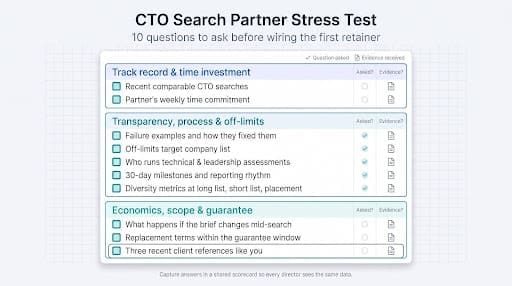
A slick pitch deck is not evidence. Before you wire the first retainer, put the named partner through this 10-question stress test:
- Show us three comparable CTO searches you closed in the past 24 months. List titles, stages and sectors.
- Who personally drove each one, and how many hours per week did you invest? Time is the scarce asset, not tools.
- What went wrong during those searches, and how did you fix it? A credible failure story signals transparency.
- Which target companies are off-limits because of existing clients? Better to learn now than halfway through the map.
- Who conducts the first-round technical and leadership assessment? Ask for credentials and the rubric.
- What milestones will we see in the first 30 days? Look for a draft market map, outreach cadence and reporting rhythm.
- How do you calculate diversity at long list, short list and placement? Percentages without denominators raise red flags.
- What happens if the brief changes mid-search? Scope-change fees and timelines should be explicit.
- If the hire departs within the guarantee window, what does the replacement search cost? “Free” can hide expenses.
- May we speak with three recent clients whose needs matched ours? Live references are the final reality check.
Conclusion
Put all ten answers in a shared scorecard so every director sees the same data before the engagement letter is signed. A firm that defines the mandate first, prices scope changes plainly, and hands over live references will survive the comparison. That level of transparency prevents politics later.
