


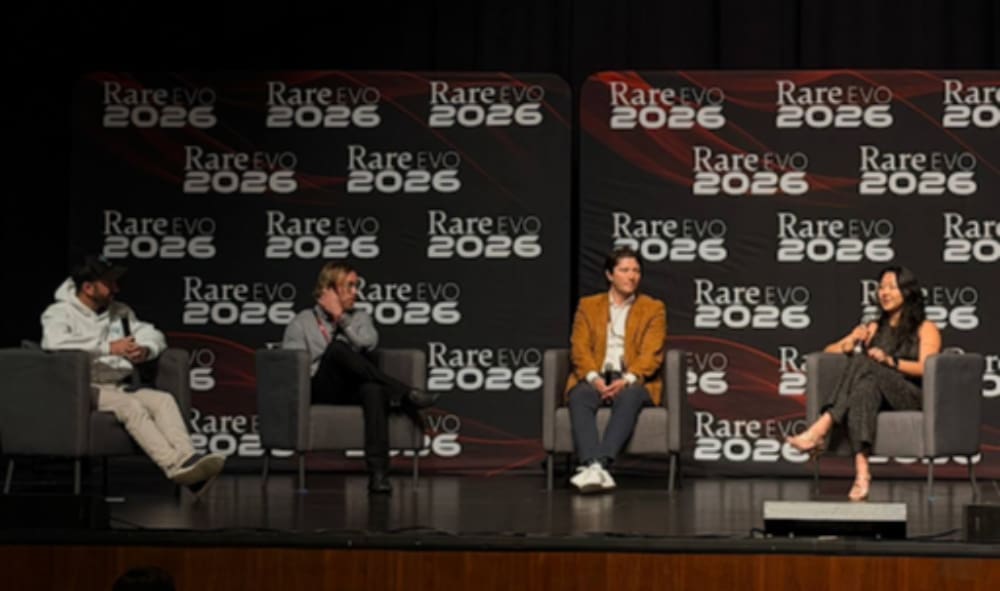
As blockchain technology matures, the conversation is shifting away from speculative assets toward real financial infrastructure. At Rare Evo held in Las Vegas this week, Margie Feng, Head of Marketing at Solayer and Margin Trade, outlined why the next stage of digital asset adoption will depend less on marketing narratives and more on whether blockchain products can deliver experiences comparable to traditional financial services.
Speaking about payments, trading infrastructure, tokenization, and the convergence of traditional and decentralized finance, Feng argued that the industry’s biggest challenge is no longer convincing people to use blockchain – it’s building products that solve real problems.
Adoption is a Product Problem
“Mainstream adoption isn’t a marketing problem – it’s a product problem, Feng said, “People adopt things that feel familiar and work better.”
She pointed to Solayer’s own consumer-facing products as examples of how blockchain technology is becoming increasingly invisible to end users.
One is Solayer Pay, a Visa-compatible payment card that allows users to spend USDC in everyday transactions. According to Feng, more than 13,000 cards have already been issued, allowing stablecoins to function much like traditional payment methods at merchants worldwide.
The other is Margin Trade, Solayer’s onchain trading platform that enables users to trade perpetual markets across cryptocurrencies, commodities, and equities using a central limit order book (CLOB) architecture. Rather than asking users to adapt to blockchain, the platform aims to deliver the execution quality traders already expect from traditional financial markets.
The broader lesson, Feng suggested, is that users rarely adopt technology because it is decentralized – they adopt products that are faster, easier, and more intuitive than existing alternatives.
Onchain Markets are Pricing the Real Economy
Blockchain markets have experienced multiple boom-and-bust cycles over the past decade, but Feng believes the current environment is fundamentally different from previous ones.
First, regulatory clarity has improved, particularly in the United States, reducing uncertainty for companies building long-term products.
Second, onchain markets are no longer limited to cryptocurrency trading. The rise of tokenized equities, Treasury products, and commodities is expanding blockchain’s role beyond digital assets.
“Previous cycles were crypto trading crypto,” Feng said. “This cycle, onchain markets are pricing the real economy.”
Finally, blockchain infrastructure itself has improved significantly. Faster execution, lower latency, and more sophisticated trading systems are making decentralized platforms increasingly capable of supporting institutional-grade financial applications.
Judge Infrastructure by its Worst Day, not its TPS
One of Feng’s strongest arguments challenged one of blockchain’s favorite benchmarks: transactions per second (TPS).
While many blockchain projects compete by advertising ever-higher throughput numbers, she argued that enterprises evaluate infrastructure very differently.
“Enterprises shouldn’t ask ‘how many TPS?’ They should ask ‘what’s your execution quality on your worst day?'”
Financial markets, she explained, are tested during periods of extreme volatility rather than normal trading conditions. Liquidation cascades, sudden spikes in trading volume, and sharp price swings reveal whether infrastructure is genuinely reliable.
For enterprise users, consistency often matters more than peak performance. Low latency, predictable execution, and stable transaction costs become essential when financial products are expected to function under stress.
Rather than treating TPS as a marketing metric, Feng believes blockchain infrastructure should be judged using the same standards as traditional exchanges.
From Infrastructure Provider to Product Builder
Solayer itself has undergone a significant transformation.
Originally focused on restaking infrastructure, the company expanded into consumer products after recognizing that performance alone would not drive adoption.
“We followed the users,” Feng explained.
Instead of waiting for others to build applications on top of its technology, Solayer began developing products that demonstrate how high-performance blockchain infrastructure can support real-world financial use cases.
Solayer Pay illustrates how stablecoins can improve payment settlement while remaining invisible to consumers through familiar payment cards.
Margin Trade applies the same philosophy to financial markets, bringing cryptocurrencies, commodities, and tokenized equities into a unified onchain trading environment.
“We stopped building infrastructure for a future someone else would build,” Feng said, “and started building that future ourselves.”
The Missing Piece in Tokenization
Tokenization has become one of the industry’s most discussed trends, with companies racing to bring stocks, bonds, commodities, and other assets onto blockchain networks.
Yet Feng believes the biggest challenge is no longer creating digital representations of assets.
The bottleneck is liquidity.
“Tokenization without a trading venue is just a PDF on a blockchain.”
Creating an onchain version of an asset is only the first step. What ultimately gives tokenized assets value is the existence of deep, transparent markets where participants can trade efficiently and discover prices continuously.
This perspective aligns closely with Margin Trade’s focus on order-book-based market structure, which seeks to provide continuous price discovery for tokenized financial products.
According to Feng, liquidity also encourages broader participation from regulators, institutions, and retail investors alike, creating a stronger foundation for long-term adoption.
Markets that Never Close
Looking ahead, Feng expects the distinction between “crypto companies” and traditional financial firms to gradually disappear.
Traditional finance is already embracing digital assets through ETFs and tokenized securities, while blockchain platforms are increasingly adopting familiar market structures such as order books, advanced risk engines, and established payment networks.
Within five years, she believes global financial markets will become continuously accessible regardless of geography or time zone.
“In five years, ‘market hours’ will sound as dated as ‘long-distance calling.'”
For traders, investors, and institutions alike, the expectation may eventually become simple: any major asset, whether a stock, commodity, or cryptocurrency, should be available around the clock through transparent, high-performance infrastructure.
