


In a decisive power play for South Africa’s connectivity future, Amazon’s satellite internet venture (formerly Project Kuiper) has sidestepped regulatory gridlock to partner with the nation’s largest ISP, firing a direct shot across the bow at a rival that remains conspicuously absent from the market.
While Elon Musk’s Starlink has successfully rolled out across neighboring African nations, it continues to face a regulatory standstill with South Africa’s Independent Communications Authority (ICASA), having failed to secure the necessary operating license.
Enter Amazon Leo, which is capitalising on this vacuum by securing a first-mover advantage through a strategic, localised distribution agreement with Herotel and its parent company, Maziv.
The deal, unveiled today, aims to connect the unconnected by 2027 through a new consumer-facing service called evry and it comes with a built-in battlefield advantage: boots on the ground.
A national rollout with local muscle
Herotel, a Maziv company and South Africa’s largest fixed internet service provider, will serve as the authorised distributor of Amazon Leo for residential customers. Through evry, the partnership targets the millions of South Africans living on farms, in small towns, townships, and rural communities where distance, difficult terrain, and low population density have historically made fiber and fixed wireless infrastructure financially unviable.
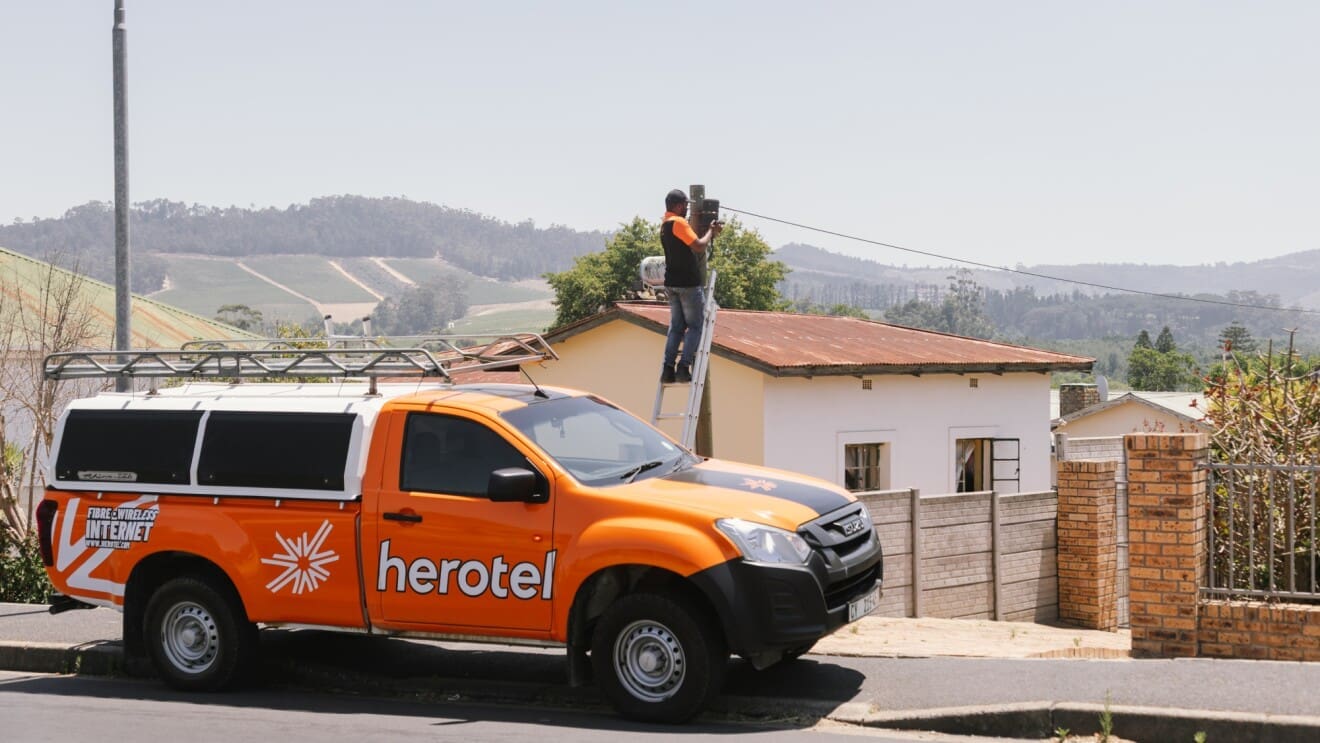
Unlike pure-play satellite providers that operate remotely, Herotel brings an immediate, tangible edge to the table. With over 350,000 active customers, a footprint spanning more than 550 towns, and 120 local offices nationwide, the ISP can offer local installation, field operations, and customer support from day one.
“evry represents the next chapter in what Herotel has been building for more than a decade,” said Van Zyl Botha, CEO of Herotel.
“We have always believed that South Africans outside the major metros — whether on farms, in small towns, in townships, or in rural communities — deserve reliable, affordable internet. With evry, powered by Amazon Leo, we will reach the customers that even fibre and fixed wireless cannot serve.”
The tech behind the ambition
Amazon Leo’s low Earth orbit (LEO) satellites operate approximately 590 kilometers above the planet, a dramatic reduction compared to traditional geostationary satellites parked at over 35,000 kilometers. This proximity drastically lowers latency, making bandwidth-hungry applications like video calls, 4K streaming, remote work, online learning, and smart farming genuinely seamless.
The constellation is interconnected via high-speed optical mesh links, ensuring reliable performance without heavy reliance on terrestrial backhaul. Customers will connect through compact, user-friendly antennas, including the Amazon Leo Pro and Nano models, available directly through evry.
Why this matters now and the $16.9 billion question
This announcement is not just about internet access; it is about economic liberation.
According to a report by Access Partnership, non-geostationary satellite systems could generate up to $16.9 billion in annual economic benefits for southern Africa, a region where nearly a quarter of the population remains entirely outside network coverage.
While Starlink has the head-start in global brand recognition, its absence from the South African regulatory roster gives Amazon Leo and Herotel a critical window to establish trust, infrastructure, and market share.
Furthermore, Amazon’s commitment to the region extends beyond this deal. Vanu, Inc., a mobile network equipment provider, is also working with Amazon Leo to bring cellular connectivity to rural communities across the continent, starting right here in South Africa.
“Amazon Leo and Herotel share the same mission to empower all South Africans through access to high-speed internet,” said David Zapolsky, Amazon’s Chief Global Affairs and Legal Officer.
“Herotel has spent years building connectivity across South Africa’s farming towns, small businesses, and communities on the outskirts, and with Amazon Leo, they can now reach even more people. This collaboration is about breaking down barriers and unlocking opportunity for millions of people who don’t yet have reliable access for work, education, or the services they depend on.”
Local support for a national challenge
The evry service is designed to be as practical as it is powerful. With Herotel’s existing national operating base, customers won’t be left to navigate installation or troubleshooting alone.
“We have spent years listening to customers who wanted reliable internet but did not have a practical option,” said Estiaan Ferreira, CCO of Herotel.
“evry will give farms, game reserves, rural homes and underserved communities a practical way to get online, with Herotel teams available to support them on the ground.”
When can South Africans get connected?
While the commercial launch is scheduled for 2027, Amazon Leo already has more than 390 satellites deployed – enough to begin initial service this year across certain latitudes, with coverage and capacity expanding rapidly.
South Africans eager to be among the first to experience evry can register their interest today at www.evry.co.za to receive updates on products, pricing, and service availability ahead of the official rollout.
