
Close Menu
  • Homepage
  • News
  • Cloud & AI
  • ECommerce
  • Entertainment
  • Finance
  • Opinion
  • Podcast
  • Contact

Subscribe to Updates

Get the latest technology news from TechFinancials News about FinTech, Tech, Business, Telecoms and Connected Life.

What's Hot

Mettus Launches Splendi App To Help Young South Africans Manage Their Credit Health

2026-01-22

The Fintech Resilience Gap: Why Africa’s Next Decade Depends On Structural Integrity

2026-01-22

Resolv Secures $500,000 Pre-Seed To Build The Recovery Layer For Stolen Crypto

2026-01-21
Facebook X (Twitter) Instagram
Trending
  • Mettus Launches Splendi App To Help Young South Africans Manage Their Credit Health
Facebook X (Twitter) Instagram YouTube LinkedIn WhatsApp RSS
TechFinancials
  • Homepage
  • News
  • Cloud & AI
  • ECommerce
  • Entertainment
  • Finance
  • Opinion
  • Podcast
  • Contact
TechFinancials
Home»Latest News»South African Hominin Fossils Were Sent Into Space And Scientists Are Enraged
Latest News

South African Hominin Fossils Were Sent Into Space And Scientists Are Enraged

The ConversationBy The Conversation2023-09-26Updated:2023-09-26No Comments5 Mins Read
Share Facebook Twitter Pinterest LinkedIn Tumblr Email
Fossils
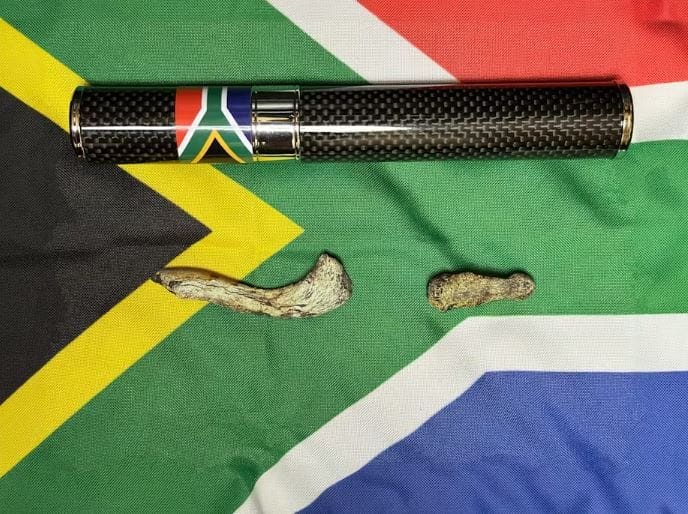
The fossils with the carbon fibre tube they were kept in on the space flight. Wits University
Share
Facebook Twitter LinkedIn Pinterest Email Copy Link

by Dipuo Winnie Kgotleng, University of Johannesburg and Robyn Pickering, University of Cape Town

When a Virgin Galactic commercial flight soared into space on 8 September 2023, there were two Virgin Galactic pilots, an instructor and three passengers on board – as well as two fossils of ancient prehuman relatives from South Africa. Timothy Nash, a businessman, carried a clavicle belonging to Australopithecus sediba and the thumb bone of a Homo naledi specimen. The fossils’ brief journey – the VSS Unity’s flight lasted just an hour – was organised by palaeontologist Lee Berger, who led the team that discovered and described Homo naledi in 2015. Berger was granted an export permit in July by the South African Heritage Resources Agency (SAHRA) to take the fossils from the country to the US launch site for VSS Unity. SAHRA is a “national administrative body responsible for the protection of South Africa’s cultural heritage”.

The event has drawn the ire of scores of human evolution researchers from South Africa and beyond. Some have labelled it “unethical” and a “publicity stunt”. Berger has not yet responded to the furore. In a statement quoted by Nature, SAHRA said it was “satisfied that the promotional benefit derived was appropriately weighted against the inherent risk of travel of this nature”.

The Conversation Africa asked Dipuo Winnie Kgotleng, director of the Palaeo-Research Institute at the University of Johannesburg, and Robyn Pickering, co-director of the Human Evolution Research Institute at the University of Cape Town, why the space flight created such unhappiness.

Why are scientists so angry about the fossils being sent to space?

There are a number of reasons.

One is the threat to South African heritage. According to the SAHRA permitting policy, fossils of this nature are only allowed to travel for scientific purposes and should be securely packed to prevent damage. The fossils travelled in space in a sealed tube – and were then kept in an individual’s pocket as he floated freely.

There is no scientific reason for allowing these fossils to travel to space. No new knowledge has been generated and no community, either local or international, has been engaged on this science.

Also, doses of radiation which these specimens were exposed to during this trip could have potentially permanently altered the fossil microstructure, affecting any data which might be required in the future.

A second issue is that the A. sediba clavicle is a type specimen: it is the original physical example of the species and, if such a specimen is lost or destroyed, it is gone forever.

Finally, this event demonstrated the unequal power relations at play in accessing this invaluable heritage. Some local communities – like the people of Taung, where a 2.8 million year old child’s skull nicknamed the Taung Child was discovered in 1924 – have requested access to fossil specimens that originated from their areas. In the case of the Taung Child, there have reportedly been discussions “over a long time” to have the skull returned by the university where it is stored.

So, is it only wealthy, famous rich white men who can have access to fossils? Poor communities do not have access to the same privileges?

Professor Berger’s SAHRA application called the fossils’ space flight a ‘once in a lifetime opportunity to bring awareness to science, exploration, human origins and South Africa and its role in understanding Humankind’s shared African ancestry’.

We completely disagree. Which community has been engaged in science awareness? Surely no South African or any African community has been engaged through this act?

Some have argued that the space flight echoes colonial attitudes to human remains. How so?

This is an example of what we call neo-colonialism. The science of human evolution has a long, dark past of exploitation and extraction. The main perpetrators of this past were privileged white men, so this latest event feels familiar but is really not OK in 2023.

Our field is just beginning to grapple with its past, and we’ve made some progress in the last decade. Something like this puts us right back into the olden days.

So what happens next?

Several professional bodies in various African regions have issued statements expressing their unhappiness about the treatment of the fossils.

Various arms of the palaeoscience community, such as the Association of Southern African Professional Archaeologists, have directly asked SAHRA and the Cradle of Humankind Management Authority (which is responsible for preserving the world heritage site where the fossils were found) and the government to address us and the South African public more broadly.

We are also pushing for these organisations to reflect on this issue and to discuss changes to their permitting policy. We’re confident that the outrage we’ve demonstrated will guard against something like this happening again in the future.

September is Heritage Month in South Africa, a time when we are asked to come together as a country, to celebrate, learn about and explore our heritage as a way to build unity in a diverse society. Our common heritage, represented by the fossils, is a great tool for bringing us together as a country. Treating the same fossils in this way goes against this noble aim.The Conversation

Dipuo Winnie Kgotleng, Director, University of Johannesburg and Robyn Pickering, Senior lecturer, University of Cape Town

This article is republished from The Conversation under a Creative Commons license. Read the original article.

human evolution neocolonialism South African heritage Space Tourism Virgin Galactic
Share. Facebook Twitter Pinterest LinkedIn Tumblr Email
The Conversation
  • Website

Related Posts

OPPO Reno15 Series Launches In South Africa

2026-01-20

Kili Technologies: Unlocking Africa’s Clean Energy Potential With Trusted Data

2026-01-19

Luminance Expands In Africa Amid Demand Surge

2026-01-15

Mpumalanga’s Top Matric Achiever Luyanda Ndlozi Rewarded With Brand New Car

2026-01-14

Say Hello To Haier: Intelligent Appliances Designed For SA’s Future

2026-01-14

Mr Price Foundation Invites Coffee Entrepreneurs To Apply For Growth 0pportunity

2026-01-14

Salesforce Announces the General Availability of Slackbot – Your Personal Agent for Work

2026-01-13

Nissan LEAF Named World’s Best Compact Car By Women’s Worldwide Car Of The Year Jury

2026-01-13

Victory For Members: MediCheck Forces Reversal of Discovery Health’s R170 Million “Clawback”

2026-01-12
Leave A Reply Cancel Reply

DON'T MISS
Breaking News

Huawei Says The Next Wave Of Infrastructure Investment Must Include People, Not Only Platforms

As countries push ahead with digital transformation, infrastructure planning is evolving. It is no longer…

Cartesian Capital Expands Investor Toolkits With JSE Listings

2026-01-20

South Africa: Best Starting Point In Years, With 3 Clear Priorities Ahead

2026-01-12

How SA’s Largest Wholesale Network is Paving the Way for a Connected, Agile Future

2025-12-02
Stay In Touch
  • Facebook
  • Twitter
  • YouTube
  • LinkedIn
OUR PICKS

Mettus Launches Splendi App To Help Young South Africans Manage Their Credit Health

2026-01-22

The EX60: A Volvo That Talks Back

2026-01-20

Over R270M In Phuthuma Nathi Dividends Remain Unclaimed

2025-11-27

Africa’s Next Voice Revolution, When 5G Meets AI

2025-11-21

Subscribe to Updates

Get the latest tech news from TechFinancials about telecoms, fintech and connected life.

About Us

TechFinancials delivers in-depth analysis of tech, digital revolution, fintech, e-commerce, digital banking and breaking tech news.

Facebook X (Twitter) Instagram YouTube LinkedIn WhatsApp Reddit RSS
Our Picks

Mettus Launches Splendi App To Help Young South Africans Manage Their Credit Health

2026-01-22

The Fintech Resilience Gap: Why Africa’s Next Decade Depends On Structural Integrity

2026-01-22

Resolv Secures $500,000 Pre-Seed To Build The Recovery Layer For Stolen Crypto

2026-01-21
Recent Posts
  • Mettus Launches Splendi App To Help Young South Africans Manage Their Credit Health
  • The Fintech Resilience Gap: Why Africa’s Next Decade Depends On Structural Integrity
  • Resolv Secures $500,000 Pre-Seed To Build The Recovery Layer For Stolen Crypto
  • Huawei Says The Next Wave Of Infrastructure Investment Must Include People, Not Only Platforms
  • The Productivity Myth That’s Costing South Africa Talent
TechFinancials
RSS Facebook X (Twitter) LinkedIn YouTube WhatsApp
  • Homepage
  • Newsletter
  • Contact
  • Advertise
  • Privacy Policy
  • About
© 2026 TechFinancials. Designed by TFS Media. TechFinancials brings you trusted, around-the-clock news on African tech, crypto, and finance. Our goal is to keep you informed in this fast-moving digital world. Now, the serious part (please read this): Trading is Risky: Buying and selling things like cryptocurrencies and CFDs is very risky. Because of leverage, you can lose your money much faster than you might expect. We Are Not Advisors: We are a news website. We do not provide investment, legal, or financial advice. Our content is for information and education only. Do Your Own Research: Never rely on a single source. Always conduct your own research before making any financial decision. A link to another company is not our stamp of approval. You Are Responsible: Your investments are your own. You could lose some or all of your money. Past performance does not predict future results. In short: We report the news. You make the decisions, and you take the risks. Please be careful.

Type above and press Enter to search. Press Esc to cancel.

Ad Blocker Enabled!
Ad Blocker Enabled!
Our website is made possible by displaying online advertisements to our visitors. Please support us by disabling your Ad Blocker.